
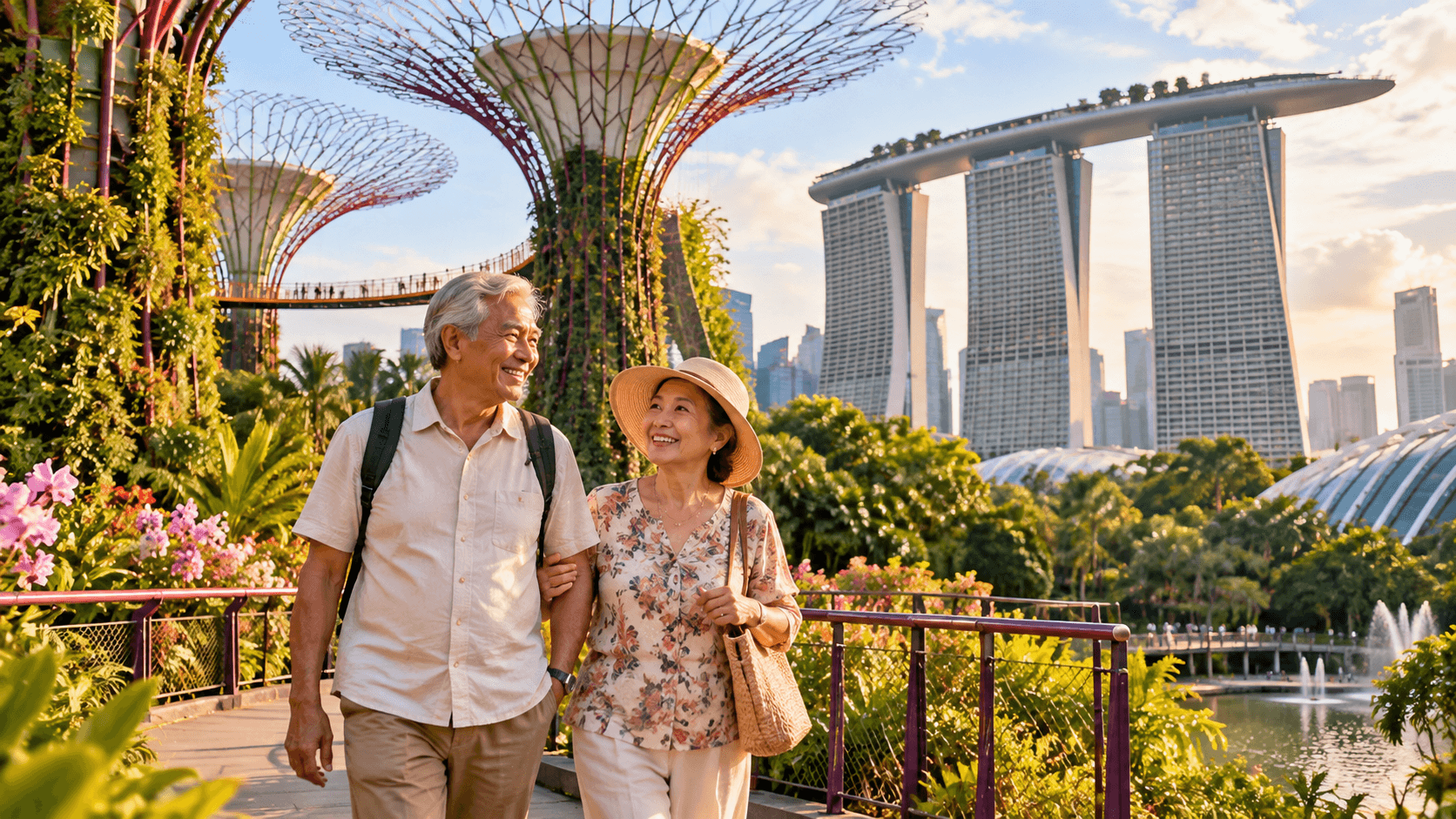
Singapore for Seniors at a Glance
| Detail | What to Expect |
|---|---|
| Best for | Relaxed sightseeing, gardens, museums, heritage areas, food, cruises, and scenic views |
| Things to do | Singapore Botanic Gardens, National Orchid Garden, Gardens by the Bay, museums, Chinatown, hawker centres, river cruises, Marina Bay, Singapore Flyer, and Changi Boardwalk |
| Getting around | MRT, public buses, taxis, and ride-hailing services |
| Walking level | Varies by attraction; choose shorter routes and allow time for seating and rest |
| Accessibility | Many major attractions and public transport facilities offer accessibility features, but check individual venues before visiting |
| Weather | Singapore is hot and humid throughout the year, with rain possible, so plan outdoor activities around the weather |
| Ideal pace | Around 2–3 main activities a day, depending on walking ability and energy |
| Planning tip | Group attractions in the same area to reduce unnecessary travel and walking |
Best for Seniors Who Enjoy Nature and Gardens
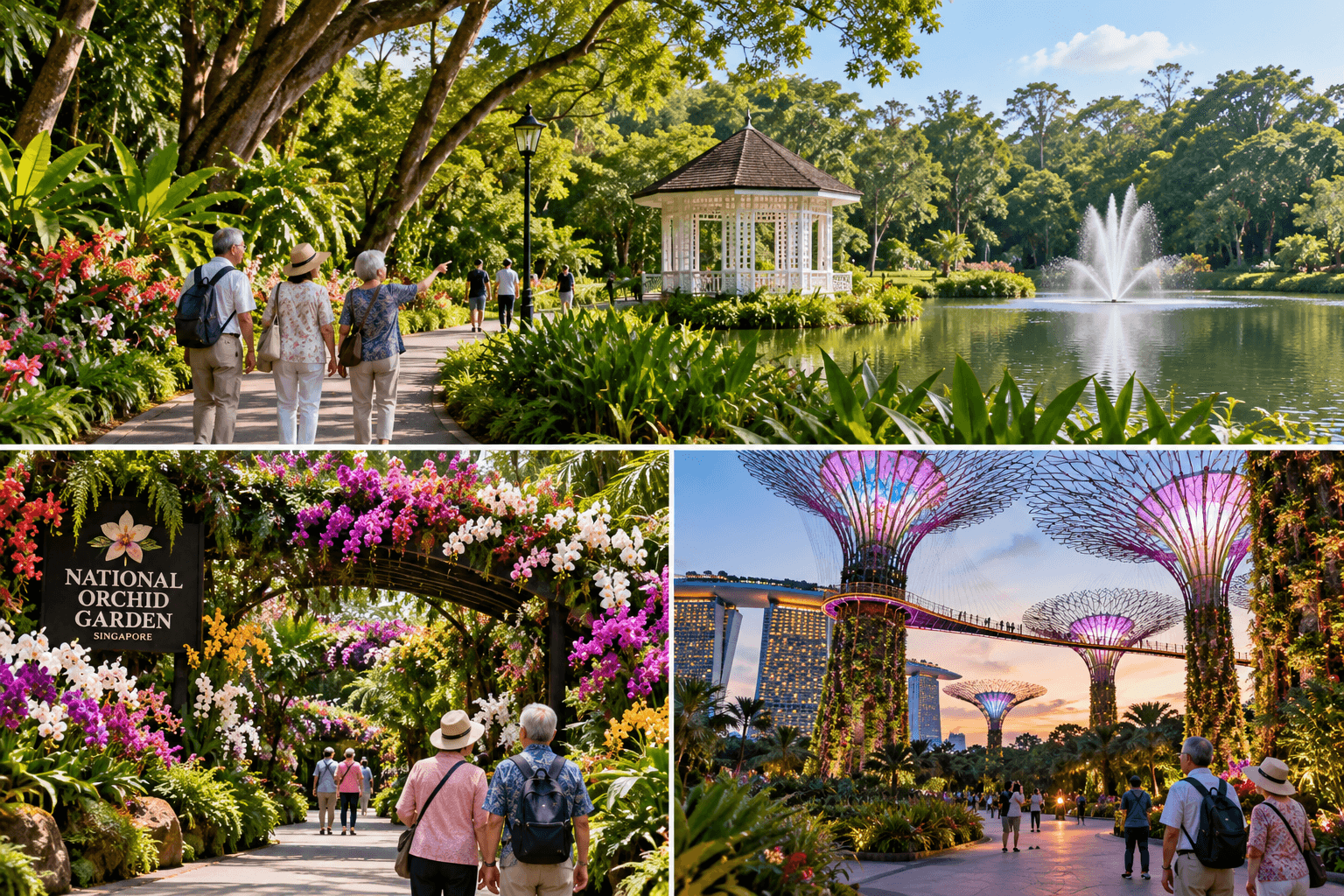
Singapore has several green spaces where you can slow down without giving up sightseeing. These three are particularly useful for older travellers because they offer different experiences: a large botanical garden, a focused orchid collection, and a mix of gardens and indoor attractions.
1. Explore Singapore Botanic Gardens
Singapore Botanic Gardens is a good option if you want to spend part of the day outdoors without committing to a fixed attraction schedule. The 74-hectare garden has several distinct areas, including the Ginger Garden, Evolution Garden, and Swan Lake, so you can choose what you want to see rather than walking the entire site.
For Singapore for seniors, the main advantage is flexibility. You can enter, explore a few sections, and leave when you have had enough. The garden also has accessible routes and facilities, although some paths and terrain can vary between areas.
What makes it worth visiting:
- Swan Lake: An easy spot for a slower stroll and views of the water.
- Ginger Garden: Features tropical plants and a waterfall.
- National Orchid Garden: Located inside the Botanic Gardens, and can be added to the same visit.
- Accessibility: Wheelchair-accessible routes are available in the gardens, but checking the route map before visiting is useful if mobility is limited.
2. Visit the National Orchid Garden
If flowers are more appealing than covering a large botanical garden, head to the National Orchid Garden. It is home to more than 1,000 orchid species and 2,000 hybrids, with displays arranged across landscaped sections.

The National Orchid Garden is a good choice for seniors who prefer a defined sightseeing experience rather than spending hours exploring a large park. The orchid displays also make it a worthwhile stop for photography.
What to expect:
- Orchid collection: Thousands of orchids in different colours and varieties.
- Cool House: A climate-controlled space featuring plants from cooler tropical regions.
- Walking: Expect garden paths and some changes in terrain, so comfortable shoes are recommended.
- Location: It is within Singapore Botanic Gardens, making it practical to visit both on the same outing.
3. Relax at Gardens by the Bay
Gardens by the Bay is useful for Singapore activities for seniors because you can choose between outdoor gardens and indoor conservatories instead of relying entirely on outdoor sightseeing. The Flower Dome, Cloud Forest, Supertree Grove, and waterfront areas each offer a different experience.

If the afternoon becomes particularly hot or rainy, the conservatories provide an indoor alternative. You can also use the attraction's shuttle service if you want to reduce the amount of walking between selected areas.
Good options for a comfortable visit:
- Flower Dome: Explore Mediterranean and semi-arid plants in an air-conditioned conservatory.
- Cloud Forest: See the indoor waterfall and mountain-themed plant displays.
- Supertree Grove: Visit for the distinctive skyline views and giant tree-like structures.
- Shuttle service: Useful for getting between selected areas when you want to limit walking.
Best for Seniors Who Enjoy History and Culture
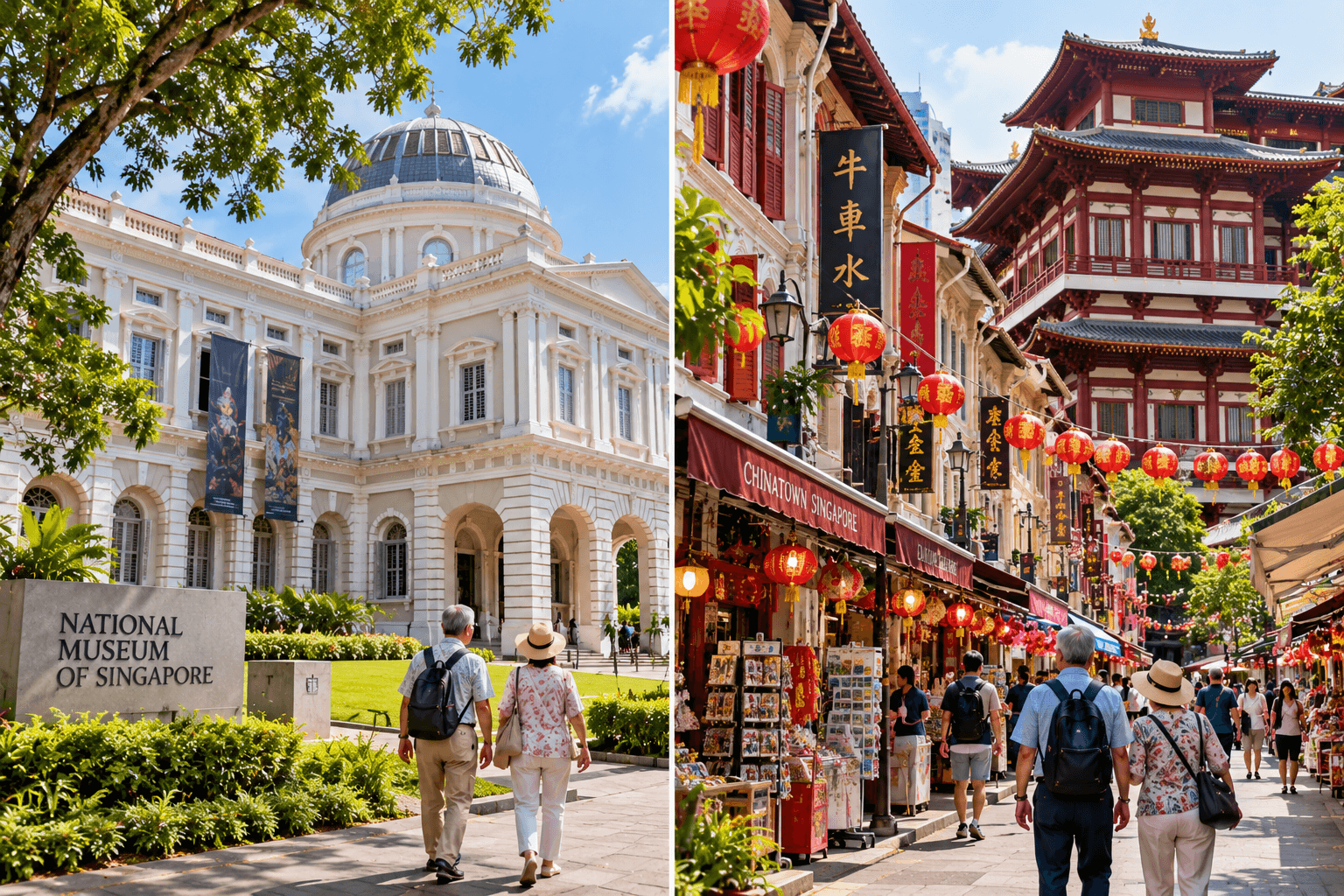
Singapore’s history is easy to explore through museums and heritage districts, so you do not have to rely on long outdoor walks to learn about the city. These two options offer different experiences: one is a structured museum visit, while the other lets you explore Singapore’s multicultural heritage through its streets, temples, shops, and food.
4. Explore the National Museum of Singapore
The National Museum of Singapore is a good choice if you want to understand the country’s history in a comfortable indoor setting. Its galleries cover Singapore’s history, culture, and development, with exhibits ranging from early settlement and trade to life in modern Singapore.
For Singapore for seniors, a museum visit can be easier to manage than spending several hours sightseeing outdoors. You can focus on the galleries that interest you rather than trying to cover every exhibit.
What to see:
- Singapore History Gallery: Follow the country's story from its early history to the modern era.
- Life in Singapore: Explore exhibits that show how people lived and how Singapore changed over time.
- Building itself: The museum occupies one of Singapore’s historic landmark buildings, dating back to the 19th century.
- Indoor setting: A useful option when you want to avoid Singapore's midday heat or rain.
5. Discover Chinatown's Heritage
Chinatown offers a more active way to experience Singapore’s history. Instead of being limited to museum galleries, you can see historic shophouses, visit temples, browse traditional shops, and stop for local food within the same neighbourhood.

For Singapore sightseeing for seniors, the area works best when explored selectively rather than attempting to cover every street. You can choose a few key landmarks and spend more time at the places that interest you.
Highlights to look for:
- Buddha Tooth Relic Temple: One of Chinatown's most recognisable landmarks, with traditional Buddhist architecture.
- Chinatown Heritage Centre: Learn about the experiences of early Chinese immigrants and the neighbourhood's development.
- Chinatown Street Market: Browse shops selling souvenirs, traditional products, and local food.
- Historic shophouses: Look for the colourful preserved buildings that give the district much of its character.
If walking through the neighbourhood becomes tiring, Singapore's MRT and bus network makes it possible to visit selected attractions without treating Chinatown as a full-day walking tour.
Best for Seniors Who Love Food and Local Experiences
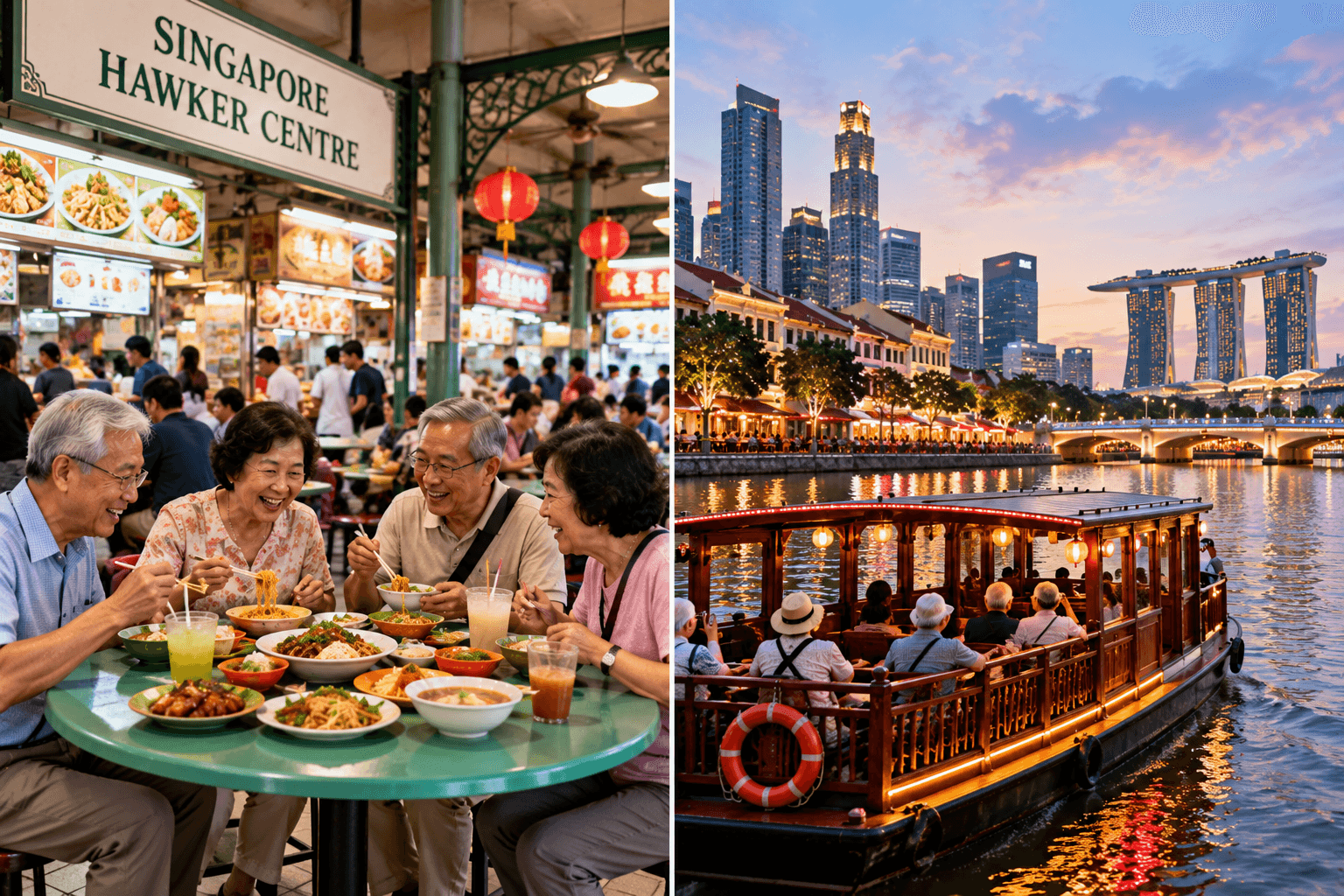
Food is one of the easiest ways to experience Singapore without building a day around major attractions. You can try local dishes at a hawker centre or see some of the city's historic landmarks from the water on a Singapore River Cruise.
6. Explore Singapore's Hawker Food Culture
Singapore's hawker centres bring together local dishes from different culinary traditions in one place. Instead of travelling across the city to try individual restaurants, you can sample several types of food at a single location.

For Singapore for seniors, this can be a simple way to experience local food while keeping the activity flexible. You can choose what to eat, how much to order, and how long to stay.
What to try:
- Hainanese chicken rice: Poached or roasted chicken served with fragrant rice and sauces.
- Laksa: A spicy noodle soup with a rich, coconut-based broth.
- Char kway teow: Stir-fried flat rice noodles with savoury sauces and other ingredients.
- Hokkien prawn noodles: Noodles cooked with prawns and a flavourful seafood stock.
- Fresh sugarcane juice: A refreshing drink option in many hawker centres.
Popular centres such as Maxwell Food Centre and Lau Pa Sat are convenient starting points, but seating, queues, and crowd levels can vary by time of day.
7. Take a Singapore River Cruise
A Singapore River Cruise lets you see several parts of the city while staying seated on a boat. The route typically passes historic riverside areas and landmarks around Clarke Quay, Boat Quay, and Marina Bay.

This makes it one of the more relaxing things to do in Singapore if you want sightseeing without walking between every landmark.
What you can see along the river:
- Clarke Quay: A historic riverside area known for its colourful shophouses and restaurants.
- Boat Quay: One of the oldest sections of Singapore's riverside, lined with restored shophouses.
- Merlion: A classic Singapore landmark visible around the Marina Bay area.
- Marina Bay skyline: Views of some of the city's best-known modern buildings from the water.
A cruise also works well as a break from land-based sightseeing. Check the boarding point and cruise schedule before going, as services and operating times can vary.
Best for Seniors Who Prefer Scenic, Low-Effort Sightseeing
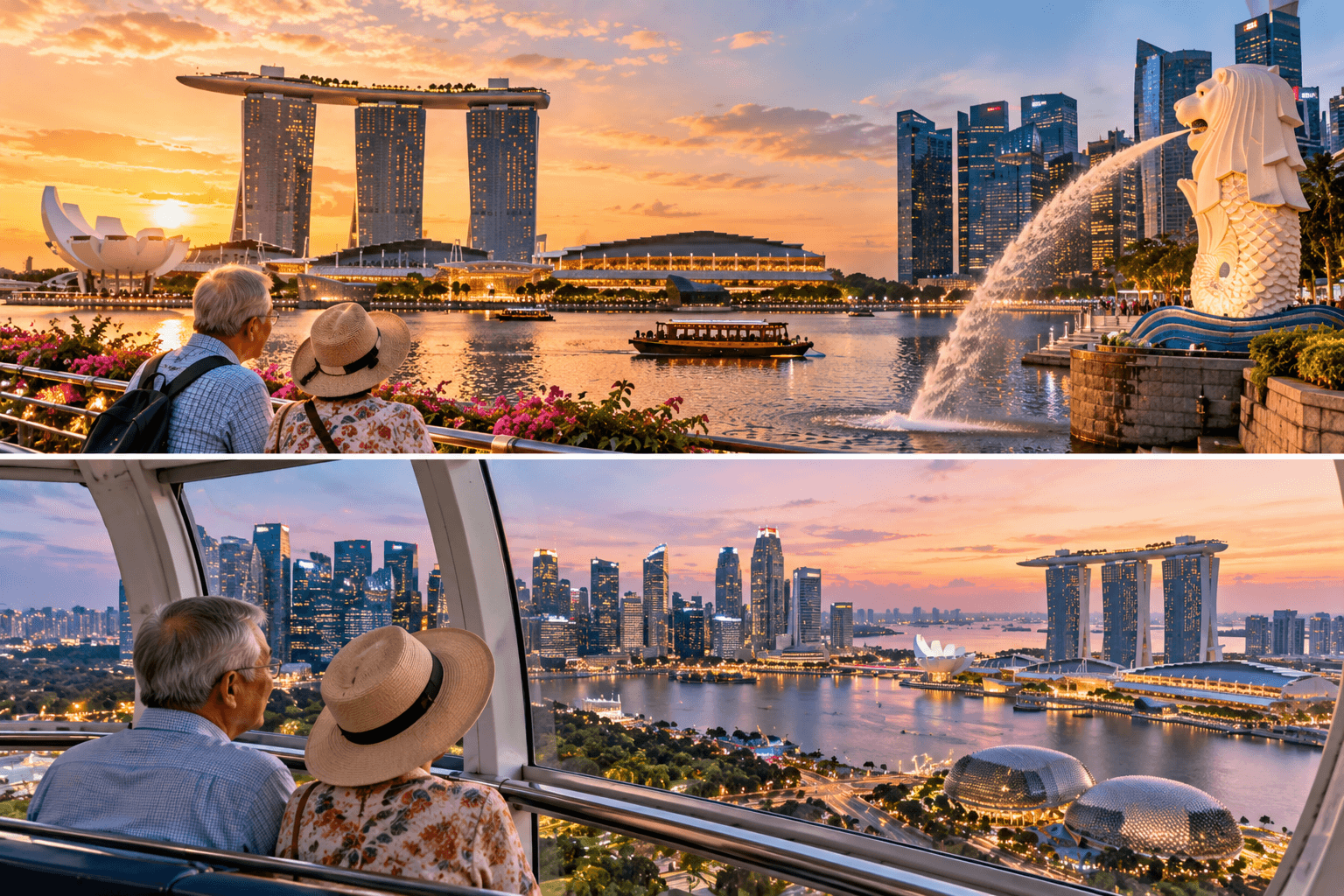
If you want to see Singapore's modern skyline without spending hours walking between attractions, the Marina Bay area and Singapore Flyer are useful options. Both offer memorable views, but in different ways: one is a waterfront area you can explore selectively, while the other gives you a seated panoramic view from above.
8. Enjoy the Views Around Marina Bay
Marina Bay brings several of Singapore's most recognisable landmarks into one area, including Marina Bay Sands, the Merlion, the ArtScience Museum, and the waterfront promenade.

For Singapore sightseeing for seniors, the advantage is that you can choose a small section of the area instead of attempting the entire waterfront. The promenade offers views across the bay, while nearby attractions provide indoor alternatives if you want to spend less time outside.
What to see around Marina Bay:
- Merlion: Stop for photos with Singapore's famous half-lion, half-fish symbol.
- Marina Bay Sands: Admire the distinctive three-tower complex from the waterfront.
- ArtScience Museum: Visit the lotus-shaped museum for exhibitions combining art, science, and technology.
- Waterfront promenade: Enjoy views across the bay and Singapore's skyline.
- Spectra: Check the schedule for the free evening light and water show at Marina Bay Sands.
9. Ride the Singapore Flyer
The Singapore Flyer is one of the easiest ways to see Singapore from above without climbing a viewpoint or walking a long trail. The giant observation wheel carries visitors in enclosed, air-conditioned capsules, with views across Marina Bay and the surrounding city.

A complete rotation takes about 30 minutes, giving you plenty of time to enjoy the scenery from your seat.
What you can see:
- Marina Bay: Look across the bay toward Singapore's major waterfront landmarks.
- City skyline: See the central business district and surrounding high-rise buildings.
- Gardens by the Bay: The Supertrees and gardens are visible from the Flyer.
- Sentosa and beyond: On clear days, the view extends toward other parts of Singapore.
The Singapore Flyer is particularly useful for senior friendly Singapore itineraries when you want a sightseeing experience that does not require continuous walking. Check the current operating status and weather conditions before visiting, as visibility can affect the views.
Best for Seniors Who Want a Quiet Coastal Escape
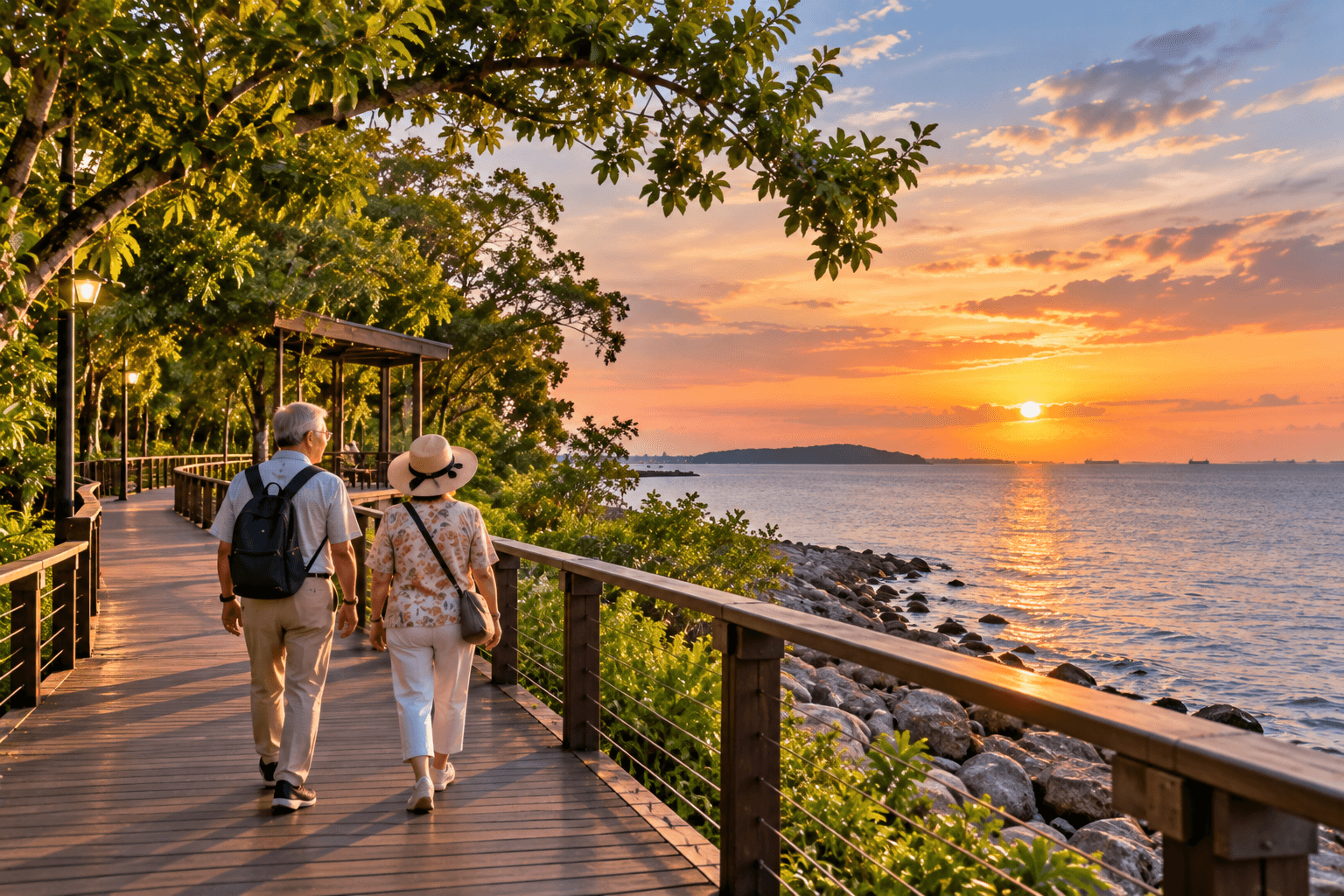
Singapore has more than busy shopping streets and city landmarks. If you want some time away from the crowds, the Changi area offers a slower coastal setting with views of the sea and passing aircraft.
10. Walk Along Changi Boardwalk
Changi Boardwalk follows Singapore's northeastern coastline, offering views of the sea, boats, and surrounding coastal landscape. It is a good option for travellers who enjoy outdoor scenery but do not want another busy attraction.
The boardwalk is made up of several sections, including the Changi Point Coastal Walk, so you can choose how much of the route you want to cover. There is no need to treat the entire boardwalk as a single long walk.
What makes it worth adding to a senior-friendly itinerary:
- Coastal views: Enjoy a different side of Singapore away from the central skyline.
- Changi Point: A scenic area with views towards Pulau Ubin and nearby waters.
- Aircraft spotting: Changi's location makes it possible to see planes approaching or departing in the distance.
- Flexible visit: Spend a short time by the coast or explore more of the route depending on your energy and the weather.
- Nearby attractions: Changi Village and Changi Point Ferry Terminal can be added if you want to make more of the trip.
For Singapore for seniors, Changi Boardwalk is best planned during the cooler parts of the day. Some sections are exposed to the sun, so check the weather before setting out and choose the length of your walk accordingly.
How to Get Around Singapore as a Senior
Singapore has several transport options, so you can choose based on how much walking, waiting, or changing you want to do. For Singapore for seniors, the MRT works well for longer journeys, while buses, taxis, and ride-hailing can be more convenient when you want to get closer to your destination.
| Transport | Best for | What to know |
|---|---|---|
| MRT | Travelling between major areas | Fast and extensive, with barrier-free facilities at many stations. Some journeys involve transfers and walking through large stations. |
| Public buses | Reaching places away from MRT stations | Useful for shorter journeys and direct routes. Check the nearest stop and walking distance before travelling. |
| Taxis | Door-to-door travel | A convenient option when you want to reduce walking, avoid transfers, or travel in hot or rainy weather. |
| Ride-hailing | Flexible point-to-point journeys | Useful when travelling from your hotel directly to an attraction or when returning after a long day. |
| Attraction shuttles | Large attractions | Some major attractions provide shuttle services between selected areas, which can reduce the amount of walking within the site. |
| Best overall approach | Combining different transport options | Use the MRT for longer city journeys and switch to buses or taxis when they offer a shorter, more comfortable route. |
Tip: When planning your day, check the distance from the transport stop to the attraction entrance, not just the distance between the stations. Grouping attractions in the same area can also reduce unnecessary travel.
Best Time to Visit Singapore for Seniors
Singapore is warm and humid throughout the year, so there is no single month that works best for every traveller. For Singapore for seniors, the more useful approach is to choose the right time of day for outdoor activities and keep indoor options available when the weather changes.
Best Time of Day for Outdoor Activities
Early morning and late afternoon are generally more comfortable for outdoor sightseeing than the middle of the day. This is especially useful for gardens, waterfront areas, and other attractions where you will spend more time outside.
| Time | Best suited for |
|---|---|
| Early morning | Gardens, coastal walks, outdoor sightseeing |
| Late morning | Museums, indoor attractions, cafés |
| Afternoon | Indoor attractions, shopping, museums, conservatories |
| Late afternoon/evening | Marina Bay, waterfront views, cruises, selected outdoor attractions |
Managing Singapore's Heat and Humidity
Singapore's tropical climate means heat and humidity can affect how comfortable you feel outdoors. If you are not used to this type of weather, avoid scheduling several outdoor activities back-to-back.
For Singapore travel tips for seniors, simple adjustments can help: wear lightweight clothing, drink water regularly, use sun protection, and choose air-conditioned attractions during the warmer part of the day.
Planning Around Rain
Rain can arrive quickly, so it is useful to have at least one indoor option in your daily plan. Museums, shopping centres, indoor conservatories, and other covered attractions can replace an outdoor activity without forcing you to cancel the entire day.
Check the forecast before leaving, particularly if your plans involve a garden, coastal walk, or other open-air attraction.
Avoiding Peak Crowds
Popular attractions and transport hubs can become busy during peak periods, especially around weekends and public holidays. Visiting major attractions earlier in the day can make sightseeing more comfortable and may give you more flexibility with your schedule.
If you prefer quieter experiences, consider visiting popular areas outside their busiest hours and avoiding a tightly packed itinerary around major tourist spots.
What Seniors Should Know Before Visiting Singapore
A little preparation can make Singapore for seniors much easier to navigate. Keep these practical points in mind before heading out:
Wear Comfortable Shoes
- Choose supportive shoes with a good grip.
- Wear footwear you have already used for walking.
- Choose shoes suited to both paved streets and garden paths.
- Avoid new or uncomfortable shoes for full sightseeing days.
Carry Water and Sun Protection
- Carry a refillable water bottle when heading outdoors.
- Use sunscreen, sunglasses, and a hat during daytime sightseeing.
- Carry a small umbrella for both sun and sudden rain.
- Take extra care with hydration in Singapore's hot and humid weather.
Check Accessibility Before Visiting
- Check for step-free entrances, lifts, and accessible toilets before visiting.
- Look for wheelchair-friendly routes if you have limited mobility.
- Check whether mobility assistance or wheelchairs are available at the attraction.
- Review the attraction's accessibility information if you use a walking aid or wheelchair.
Keep Important Travel Details Handy
- Save your hotel's name, address, and contact number on your phone.
- Keep important travel documents and emergency contacts accessible.
- Carry any essential medication you may need during the day.
- If travelling with someone, agree on a meeting point in case you get separated.
Final Thoughts
Singapore offers plenty of things to do in Singapore for seniors, from peaceful gardens and museums to river cruises, hawker food, and scenic waterfronts. You do not need to see every major attraction in one trip to enjoy the city.
The easiest way to plan Singapore for seniors is to choose activities that match your walking ability and interests, group attractions by location, and leave enough flexibility in your day. With the right pace and a little preparation, you can enjoy Singapore's gardens, culture, food, and city views without turning your trip into a rushed sightseeing schedule.