
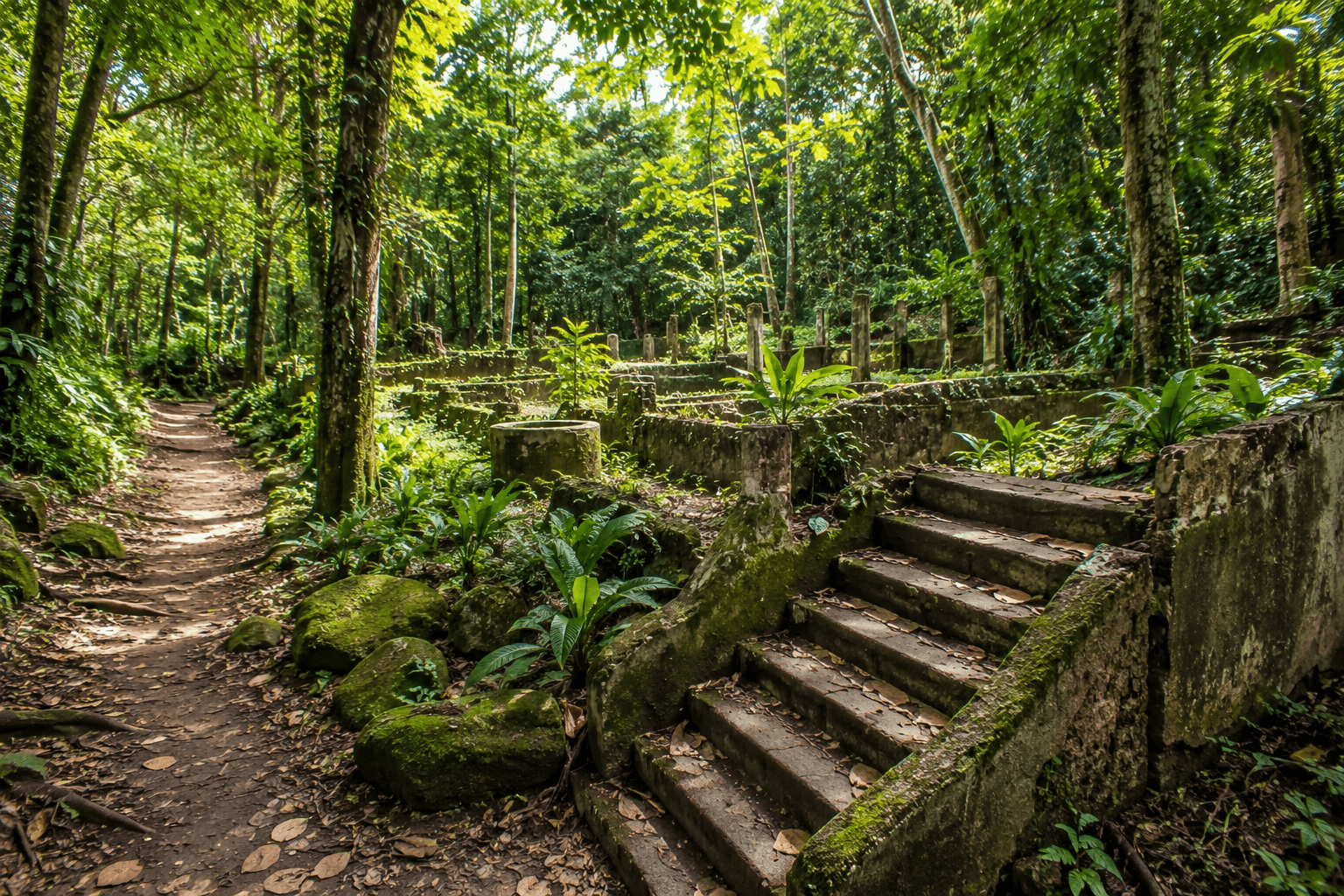
What if a walk through the forest could also take you through the remains of a village that once stood here? At Thomson Nature Park, you can follow old roads into the forest, pass the foundations of former homes, spot old wells and staircases, and see how nature has gradually reclaimed the site.
The story goes back to the 1930s, when Hainanese settlers established a village in the area. Farms and rambutan plantations surrounded the settlement, and people continued living here for decades before the village was eventually abandoned. Today, its physical traces remain scattered among the trees, giving the Thomson Park trails a sense of discovery that goes beyond a normal nature walk.
There is another reason to keep your eyes on the canopy. The park forms part of the habitat of the Raffles' Banded Langur, one of Singapore's rarest primates. You may also encounter forest birds and other wildlife as you move between streams, ferns, and secondary forest.
This guide takes you through the Hainan Village ruins, individual trails, wildlife, and conservation work, along with the practical details you need to plan your walk.
Thomson Nature Park at a Glance
| Detail | Quick Information |
|---|---|
| Location | Old Upper Thomson Road, Singapore |
| Size | 50 hectares |
| Opening hours | 7am to 7pm daily |
| Main attraction | Former Hainan Village ruins |
| Main trails | Ruins and Figs, Streams and Ferns, Rambutan, Langur |
| Total trail distance | About 3.8 km |
| Wildlife highlight | Raffles’ Banded Langur |
| Best for | Heritage walks, wildlife spotting, and easy forest exploration |
| Trail character | Forest paths, streams, roots, rocks, and old village remains |
| Nearest MRT | Lentor MRT Station |
What Makes Thomson Nature Park Special?
Thomson Nature Park brings together two sides of Singapore's landscape that you don't often experience in the same place: natural forest and local heritage. The area was once home to a Hainanese village, and today its former settlement sits within a regenerated forest that supports native wildlife.
The park is also known for its connection to the Raffles' Banded Langur, one of Singapore's rarest primates. This visit is more than just following a nature trail. You're exploring a landscape where wildlife, forest recovery, and the remains of past human activity all meet.
Why Heritage and Nature Exist Side by Side
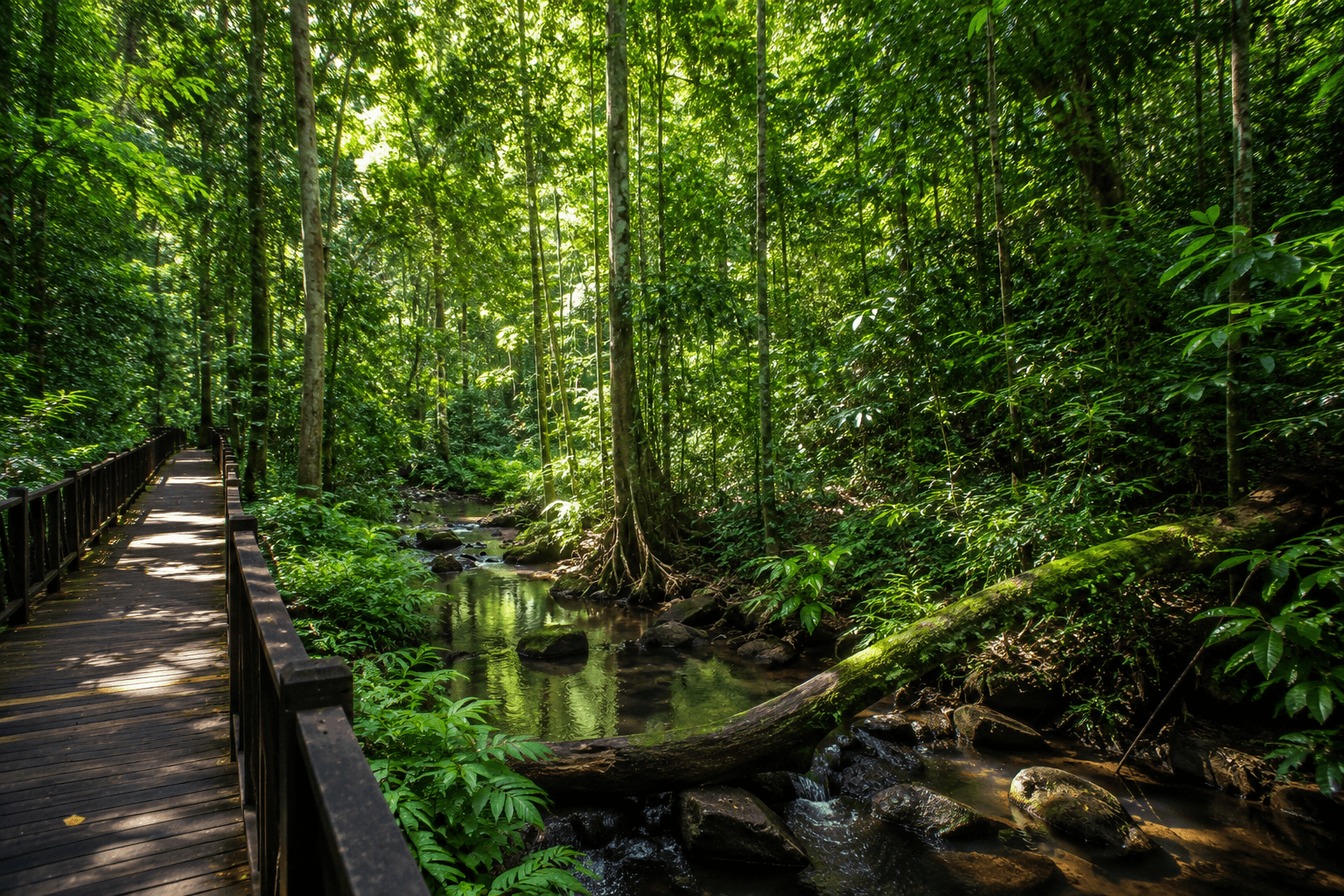
The village disappeared decades ago, but the landscape did not simply return to its original state. Vegetation gradually grew back around parts of the former settlement, creating the forest environment visitors see today.
That combination gives Thomson Nature Park its character. You can explore a natural setting while also discovering evidence of how people once lived and worked in this part of Singapore.
What Makes Thomson Nature Park Different?
| What makes it special | What you experience |
|---|---|
| Village heritage | A forest setting shaped by decades of human history |
| Regenerated forest | Woodland that has grown across a former settled area |
| Wildlife habitat | Opportunities to encounter native forest species |
| Raffles' Banded Langur | One of Singapore's rare primates |
| Heritage trails | Routes that connect the area's natural and historical features |
Walk Through the Former Hainan Village
The former Hainan Village is best explored on foot, where the surviving traces of the settlement appear along the forest trails rather than in a single heritage display. As you walk through the area, you'll come across structures and landscape features that hint at how the community once lived.
What Remains of the 1930s Village
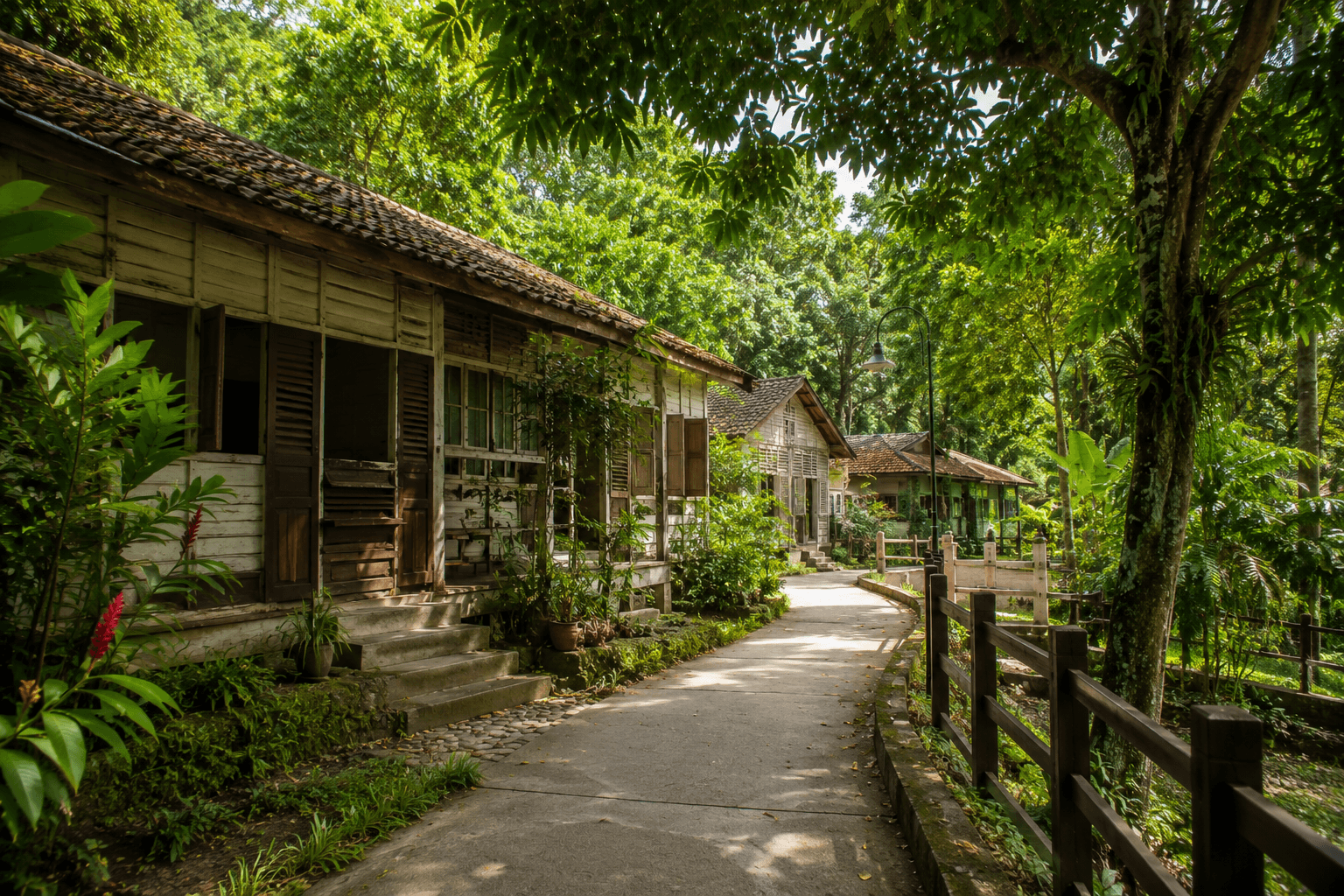
The village was established in the 1930s and grew into a small community with homes, farms, and plantations. Residents gradually moved away in the late 1980s, and the buildings were left behind as the surrounding vegetation continued to grow.
Today, several physical traces of the settlement can still be found along the trails, including:
- Building foundations marking former homes
- Concrete wells once used by residents
- Old staircases leading to former structures
- Sections of the former road network
- Walls and other remnants scattered through the forest
These remains are not reconstructed, so what you see is a glimpse of the original settlement rather than a recreated village.
Foundations, Wells, Staircases, and Old Roads
The surviving structures give you clues about everyday life in the former village. Building foundations show where houses once stood, while wells provide evidence of the facilities residents relied on. The old roads are particularly useful for understanding how the settlement was laid out.
What once connected different parts of the community is now partly covered by vegetation. The Ruins and Figs Trail is the main route for exploring these features and includes nine former village sites along the walk.
The Story Behind the Former Farms and Rambutan Plantations
Life in the village was also closely tied to agriculture. Residents cultivated crops and maintained plantations, including areas where rambutan was grown. The Rambutan Trail passes the site of a plantation cultivated from the 1930s.
Some older rambutan trees remain within the landscape, providing a physical link to the area's farming history. This part of the walk adds another dimension to the village story. The landscape wasn't simply where people built their homes; it also provided space to grow food and support the community.
How the Ruins Were Incorporated Into the Park
The surviving village remains were incorporated into the park's trail network rather than being reconstructed as a replica of the original settlement. This means the heritage features appear within their natural surroundings as you explore.
You may encounter a foundation beside the trail, come across an old staircase, or notice a wall partly surrounded by vegetation. The setting helps show how the former settlement has changed over time while allowing visitors to see the remnants themselves.
This approach makes the heritage feel discovered rather than staged. Instead of walking through a recreated village, you can see the surviving foundations, wells, staircases, and other structures within the forest and get a clearer sense of how the community was once laid out.
Choose Your Thomson Nature Park Trail
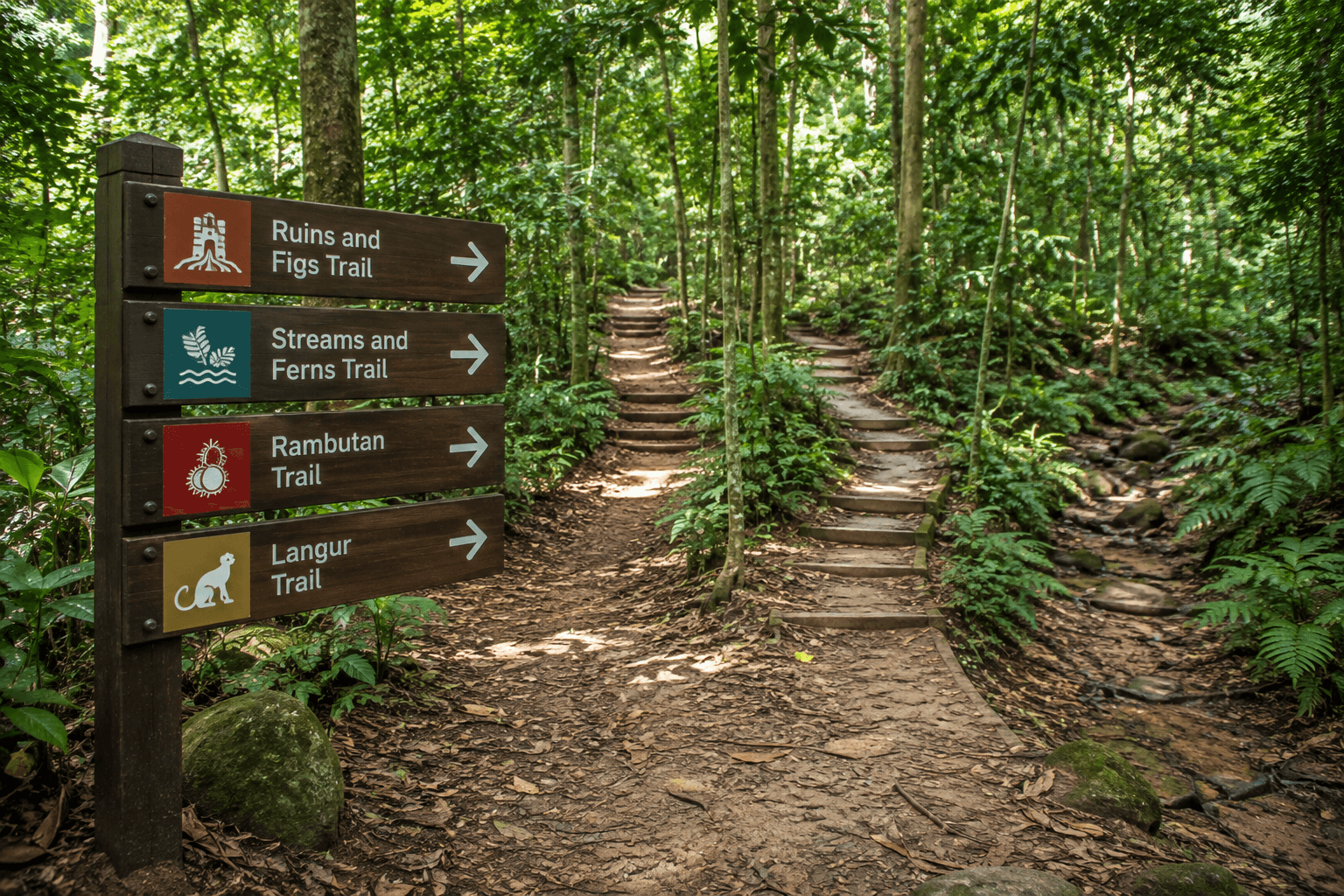
The four Thomson Nature Park trails are short enough to combine, but each one gives you a different reason to step onto the forest floor.
If you are mainly here for the old village, head for the ruins. If you want streams and forest, take the longer nature trail. The two shorter routes are useful when you want to see a specific part of the park without doing the full walk.
| Trail | Distance | Best reason to take it |
|---|---|---|
| Ruins and Figs Trail | 1.5 km | Former Hainan Village ruins |
| Streams and Ferns Trail | 1.4 km | Streams, ferns and forest habitat |
| Rambutan Trail | 400 m | Former rambutan plantation |
| Langur Trail | 150 m | Lookout deck and quick forest walk |
Ruins and Figs Trail for the Strongest Heritage Experience
This is the trail to choose if the Hainan Village ruins are what brought you to Thomson Park. Along the 1.5-km route, you'll come across nine former village sites, including:
- House foundations
- Old wells
- Concrete walls
- Staircases
- Sections of the former road network
- Mature fig trees
The interesting part is that these aren't reconstructed features. They are surviving pieces of the original settlement, now surrounded by secondary forest.
Take your time around the foundations and old roads. Together, they give you a better idea of how the village was arranged than a single preserved building ever could.
Streams and Ferns Trail for Forest and Freshwater Scenery
The Streams and Ferns Trail shifts the focus away from the village and into the natural landscape. You'll pass:
- Small freshwater streams
- Fern-covered areas
- Shrubs and forest vegetation
- Rocky sections
- Exposed tree roots
At 1.4 km, it is almost as long as the Ruins and Figs Trail, but the experience is quite different. There are fewer obvious heritage features and more opportunities to pay attention to the forest floor, streams and surrounding vegetation.
Wear shoes with a good grip here, especially after rain. The rocks and exposed roots make this the section where you are more likely to need to watch your footing.
Rambutan Trail for a Short Historical Detour
The 400-metre Rambutan Trail is short, but it adds an important piece to the story of the former village. The area was once used as a rambutan plantation, dating back to the 1930s. So rather than seeing the village only as a residential settlement, this trail shows how the surrounding land was also used for cultivation.
It's a particularly easy addition if you've already walked the Ruins and Figs Trail and want to see another part of the area's agricultural history without adding a long distance to your walk.
Langur Trail for a Quick Introduction to the Park
At only 150 metres, the Langur Trail is the quickest way to get a feel for the park. It includes:
- A short boardwalk
- A lookout deck
- A small historical ruin
- Forest surroundings associated with the Raffles' Banded Langur
Despite its name, the trail does not guarantee a langur sighting. These primates spend much of their time high in the forest canopy, so even a good lookout does not mean you'll automatically spot one. If you're short on time, this is a convenient introduction.
If you came specifically for the ruins and heritage, the Ruins and Figs Trail is the stronger choice. For a more nature-focused walk, Streams and Ferns gives you considerably more to explore.
Wildlife at Thomson Nature Park
Thomson Nature Park is one of the places in Singapore where wildlife conservation is very visible. NParks specifically highlights the park for the Raffles' Banded Langur, Lesser Mouse-deer and Long-tailed Macaque, while its forest also supports species such as the critically endangered Straw-headed Bulbul, Little Spiderhunter and Asian Brown Flycatcher.
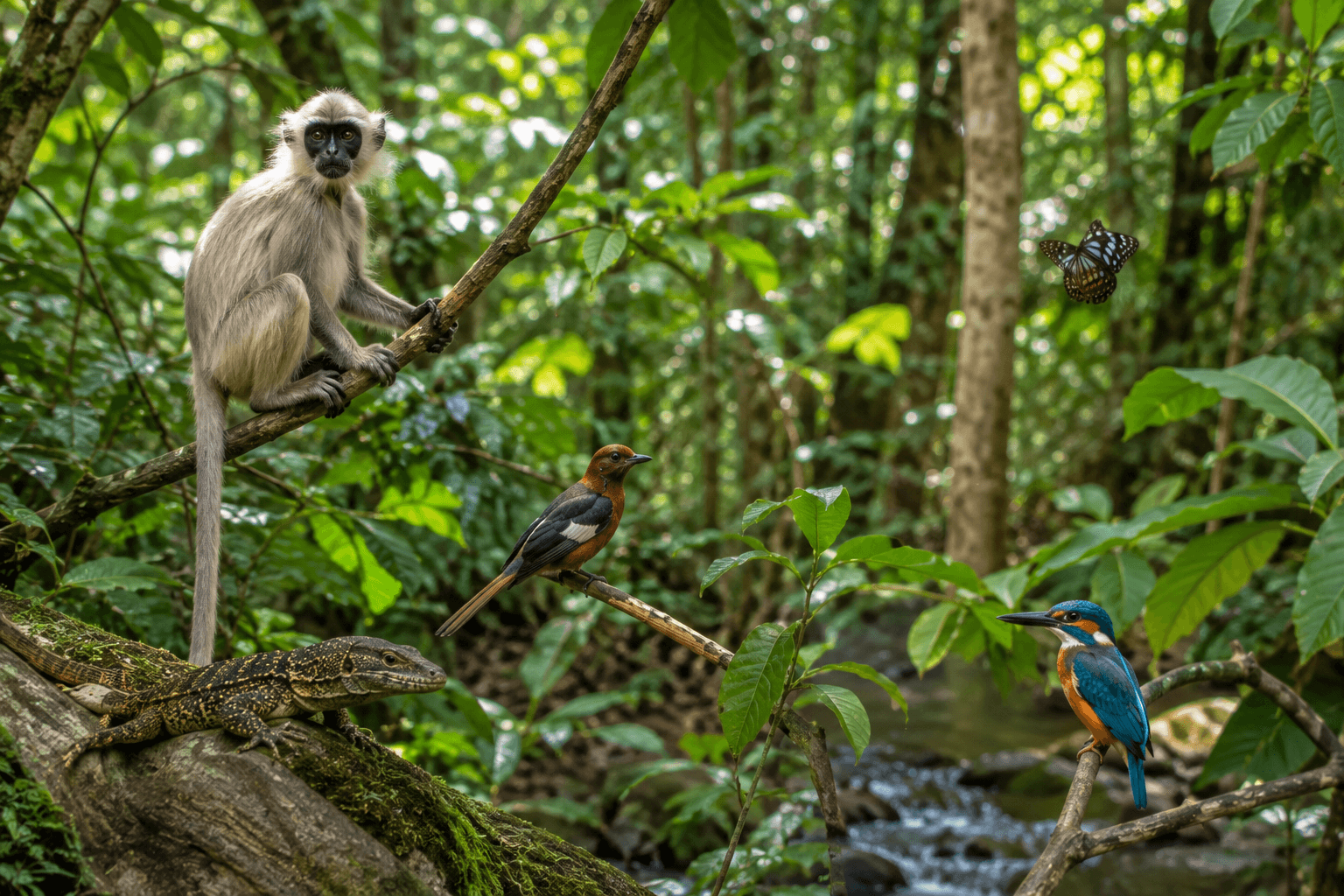
The Raffles' Banded Langur Is the Main Wildlife Highlight
If there is one animal worth keeping your eyes on the canopy for, it is the Raffles' Banded Langur. This critically endangered primate has a very distinctive appearance:
- Sleek black fur
- A white band running down the chest and belly
- White rings around the eyes
- White patches on the inside of the limbs
It is also much harder to spot than its appearance might suggest. The species is strictly arboreal, spending its life high in the forest canopy rather than regularly coming down to the ground.
That means the best strategy isn't to stare at the trail looking for an animal crossing your path. When you're near the Langur Trail, look into the upper branches and listen for movement in the canopy.
Other Animals to Look For
The langur gets most of the attention, but Thomson Nature Park has several other species worth knowing before you visit.
| Species | What makes it interesting |
|---|---|
| Lesser Mouse-deer | One of the world's smallest hoofed animals, with a reddish-brown body and white underparts |
| Long-tailed Macaque | Common in the area and usually seen moving in social groups |
| Straw-headed Bulbul | A critically endangered forest bird found in the park |
| Little Spiderhunter | A small forest bird that feeds around flowering plants |
| Asian Brown Flycatcher | A migratory bird that can be seen in the forest |
| Red-crowned Barbet | Singapore's only forest-dwelling barbet, associated with the Bukit Timah and Central Catchment forests |
The Red-crowned Barbet is particularly interesting if you're interested in birds. It excavates nest cavities in trees and feeds on large forest fruits, helping disperse seeds that smaller birds cannot handle.
Why You Might Walk the Whole Trail and See Nothing
This is worth understanding before visiting Thomson Park: it is a wildlife habitat, not a wildlife enclosure. A Raffles' Banded Langur may be somewhere in the surrounding canopy without ever coming into view.
The Lesser Mouse-deer is similarly difficult to spot, while birds can disappear into dense vegetation before you even realise they were there. So don't plan the visit around a guaranteed animal encounter. Instead, give yourself more chances by:
- Walking quietly through the forest.
- Looking upward at different points rather than only ahead.
- Pausing around fruiting trees and dense vegetation.
- Spending a little longer around the Langur Trail.
- Listening for bird calls before trying to locate the bird itself.
The Park Is Being Changed to Help the Langurs
This is where Thomson Nature Park becomes particularly interesting from a conservation perspective. NParks has carried out enrichment planting of more than 1,000 native trees in the park, including species that provide food for Raffles' Banded Langurs, such as Radermachera pinnata and Nothaphoebe umbelliflora.
The conservation work also addresses something much bigger than simply planting trees. Raffles' Banded Langurs move through the forest canopy, so crossing roads can be dangerous. Rope bridges have been installed across Old Upper Thomson Road to give them and other tree-dwelling animals an aerial route between forest areas.
There's even a wildlife detection system along the road that uses video analytics to identify animals approaching the roadway and alert motorists. So when you see a rope bridge above Old Upper Thomson Road, it's not just an unusual feature for visitors to photograph. It is part of an active attempt to keep an endangered primate moving safely through its remaining habitat.
How Thomson Nature Park Protects Its Natural Habitat
Thomson Nature Park isn't simply a green space left beside the Central Catchment Nature Reserve. Its planting, wildlife crossings and habitat management are designed to support species that need connected forest, particularly the Raffles' Banded Langur.
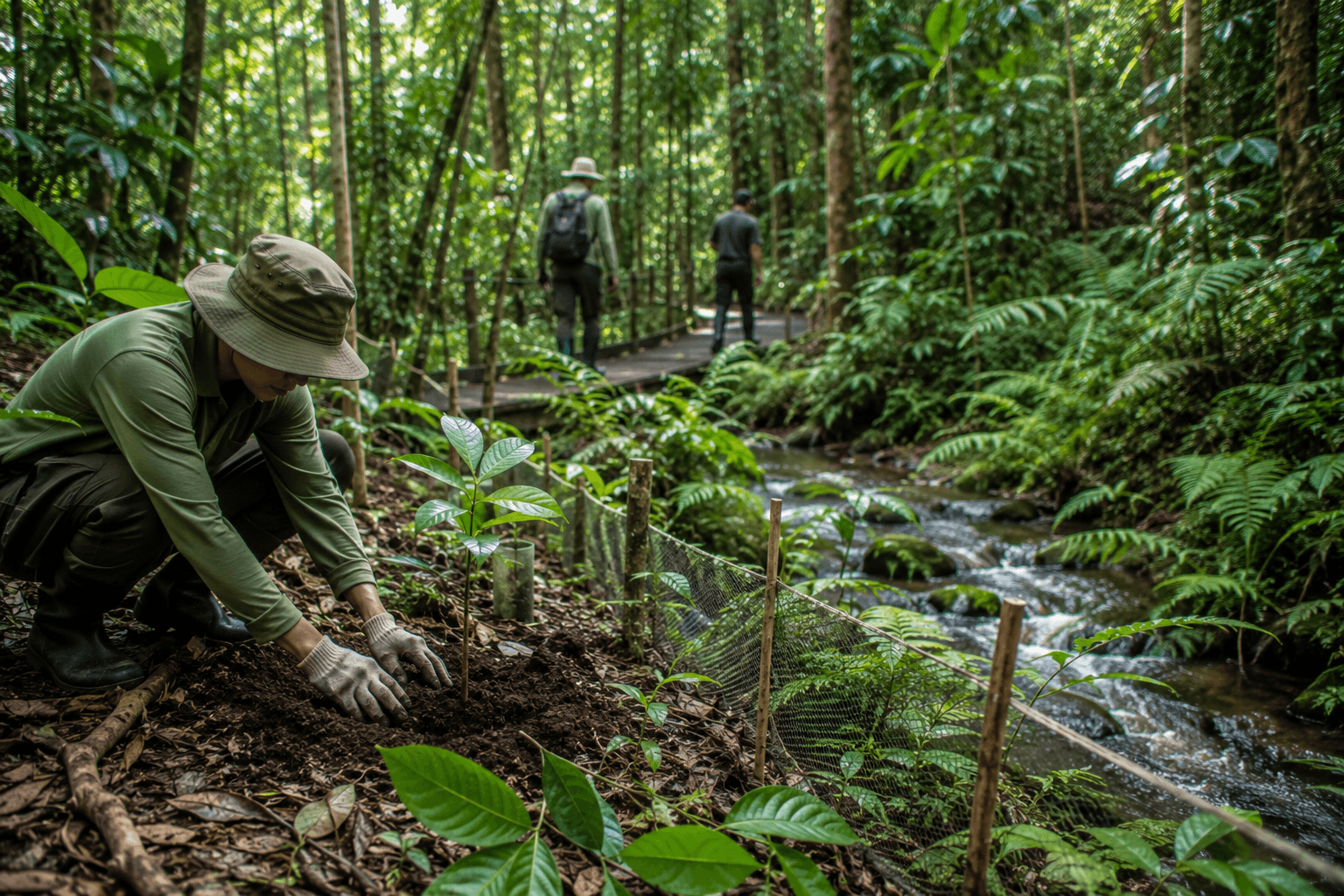
Restoring Native Forest Around the Former Village
The former Hainan Village was once surrounded by homes, farms and plantations. After residents left, vegetation gradually returned, and the area developed into a secondary forest.
Rather than clearing this growth to recreate the village, conservation work has focused on strengthening the forest around the surviving ruins.
Key elements include:
- Retaining existing forest vegetation where possible
- Adding native tree species
- Maintaining habitat around the former village
- Preserving the historical ruins within the recovering forest
This creates the unusual setting you'll notice on the Ruins and Figs Trail: concrete remnants of the old settlement surrounded by living forest.
Creating Food Plants for the Raffles' Banded Langur
The planting programme has a specific target too. NParks has planted more than 1,000 native trees to strengthen habitat for wildlife, including food plants used by the Raffles' Banded Langur.
Some of the species planted include:
| Native tree | Conservation role |
|---|---|
| Radermachera pinnata | Provides food resources for Raffles' Banded Langurs |
| Nothaphoebe umbelliflora | Part of the native planting programme supporting langur habitat |
These trees are important because conservation isn't only about giving animals somewhere to live. They also need enough food within that habitat to remain there.
Rope Bridges and Wildlife Crossings
The most striking conservation feature is easy to spot from the road. Rope bridges cross Old Upper Thomson Road, allowing arboreal animals to travel between forest areas without descending onto the road. They are particularly important for Raffles' Banded Langurs because the species spends most of its time in the canopy.
The area also uses a wildlife detection system:
- Cameras monitor the roadside.
- Video analytics can detect animals approaching the road.
- Alerts can warn motorists to slow down.
So if you see one of the rope bridges during your visit, it isn't a visitor attraction. It's infrastructure built specifically around how wildlife moves through the landscape.
Connecting the Park With the Central Catchment Nature Reserve
Thomson Nature Park sits directly beside the Central Catchment Nature Reserve, making its location important for conservation. The park helps create a wider connected green landscape rather than leaving the reserve surrounded by developed areas.
This matters particularly for species that need to move between forest patches. For the Raffles' Banded Langur, maintaining safe routes through the canopy can mean the difference between an isolated population and one that can continue using a larger habitat.
So the park serves two purposes at once: you get a heritage trail through a former village, while the same landscape provides additional forest habitat and safer movement routes for wildlife.
Planning a Thomson Nature Park Walk
A visit to Thomson Nature Park is fairly easy to plan, but the experience changes depending on which trail you choose. The routes are short, yet some sections have exposed roots, rocks, and natural surfaces, so this is better approached as a forest walk than a paved park stroll.
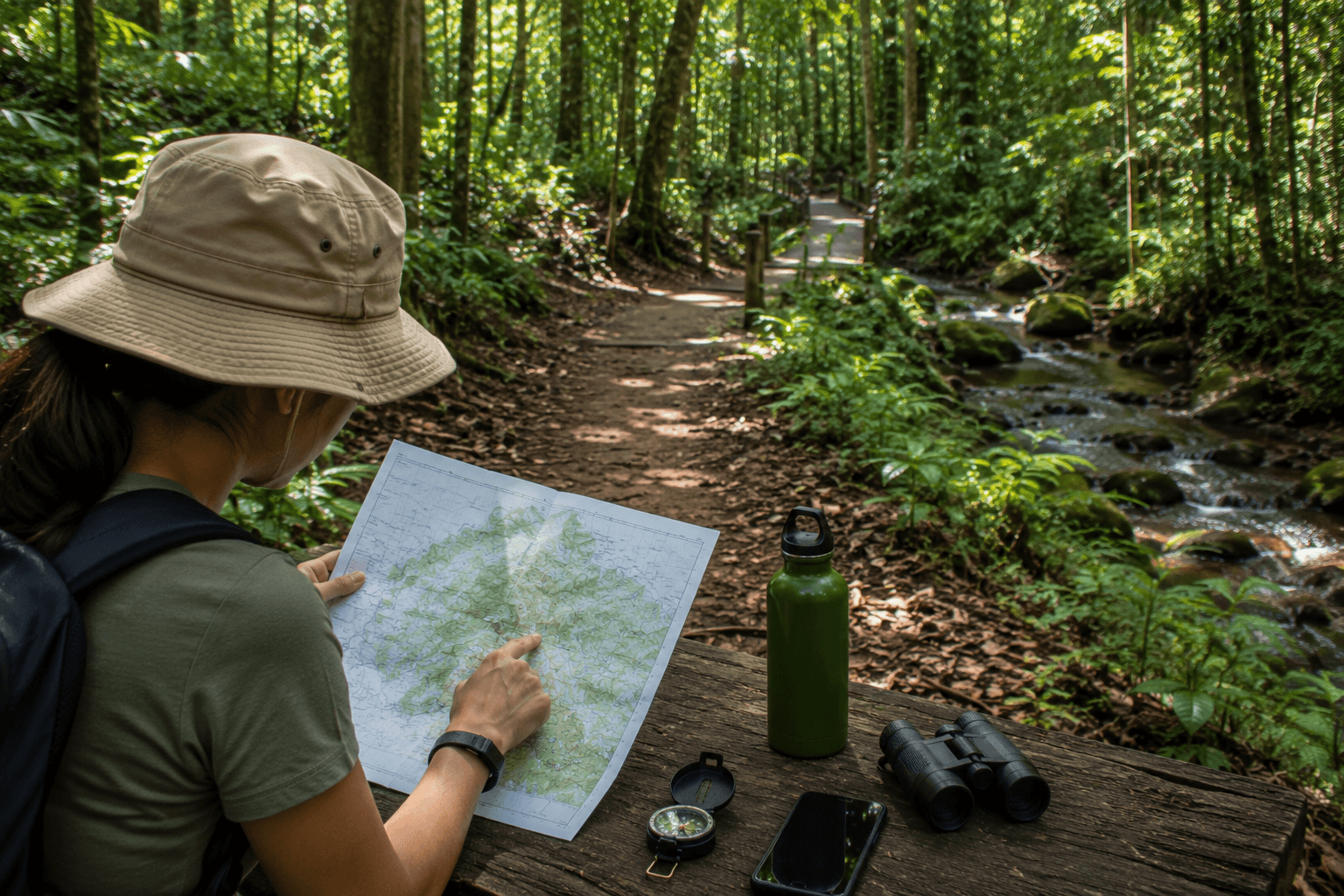
How Long the Different Trails Take
You don't need to complete every trail to enjoy the park. Choose according to how much time you have and what you want to see:
| Trail | Distance | Allow roughly | Main reason to choose it |
|---|---|---|---|
| Ruins and Figs Trail | 1.5 km | 30–45 min | Hainan Village ruins |
| Streams and Ferns Trail | 1.4 km | 30–45 min | Streams and forest |
| Rambutan Trail | 400 m | 10–15 min | Former plantation |
| Langur Trail | 150 m | 5–10 min | Lookout deck and forest |
If you want the complete experience, combine the trails and allow around 1 to 2 hours, especially if you're stopping to examine the ruins or looking for wildlife.
Getting There From Lentor MRT and by Road
Lentor MRT Station is the nearest MRT station. From there, you can continue towards the park on foot or by connecting bus services.
If you're driving, the park is accessed from Old Upper Thomson Road, where parking is available nearby. One thing to keep in mind is that the park itself isn't designed for vehicles or cycling. Once you're there, the trails are explored on foot.
What to Wear and Bring
You don't need hiking equipment, but the natural terrain makes sensible footwear worthwhile. Bring:
- Covered shoes with good grip for roots, rocks, and uneven sections
- Water, particularly in Singapore's heat and humidity
- Insect repellent for the forested areas
- Sun protection for the more open sections
- Binoculars if you're hoping to spot birds or langurs
- A phone or camera if you want to photograph the ruins and forest
After rain, allow extra care around muddy or slippery sections.
Important Trail and Wildlife Etiquette
Thomson Nature Park is both a heritage site and a wildlife habitat, so how you move through it matters. While walking:
- Stay on the designated trails.
- Don't climb on or remove pieces of the old ruins.
- Avoid entering vegetation to get closer to wildlife.
- Keep noise low, particularly when watching birds or langurs.
- Never feed the animals.
And if you're hoping to see the Raffles' Banded Langur, don't follow or chase one if you are lucky enough to spot it. Watch from a distance and let it continue through the canopy.
The park is open from 7 am to 7 pm, so plan your walk within daylight hours. NParks also advises visitors to avoid entering forested areas during and immediately after bad weather.
Final Thoughts
Thomson Nature Park offers more than a typical forest walk, combining nature, wildlife, and the remains of Singapore's former Hainan Village in one setting. The trails take you past old foundations, roads, wells, and plantation areas while the surrounding forest provides habitat for species such as the Raffles' Banded Langur.
For history, the Ruins and Figs Trail is the obvious choice, while the Rambutan Trail adds more insight into the area's agricultural past. If you prefer a more nature-focused walk, Streams and Ferns offers a closer look at the forest and freshwater habitats.
What makes the park memorable is this mix of past and present. You can explore a landscape shaped by an old community while seeing how nature has reclaimed and transformed it over time.