
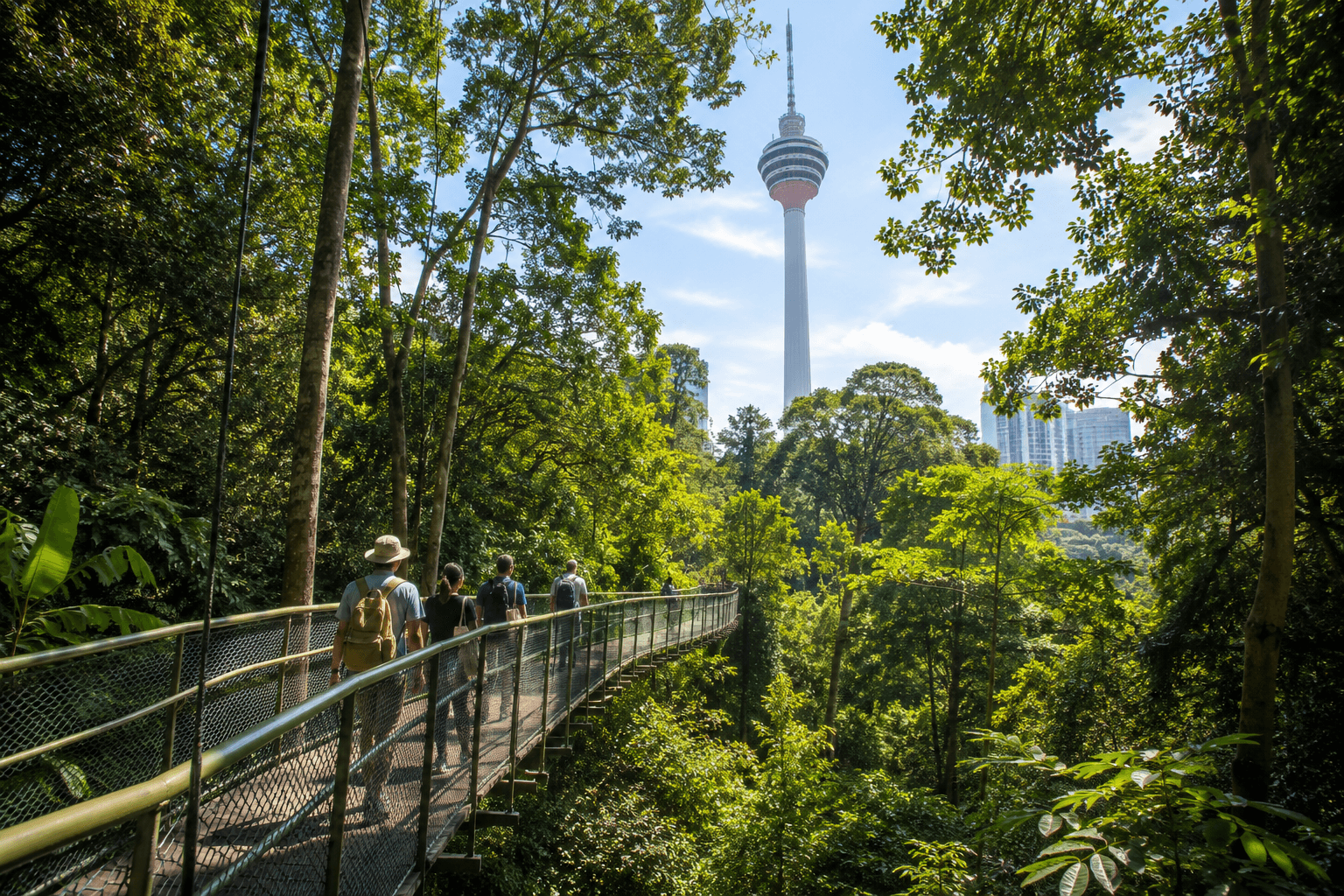
You could be standing beneath KL Tower one minute and walking through thick tropical greenery the next. That quick change of scenery is the charm of KL Forest Eco Park.
Set on Bukit Nanas, this pocket of forest gives you shaded trails, an elevated canopy walk, and the chance to see birds or monkeys among the trees, all within central Kuala Lumpur. It is an easy stop to add between city sights, but a little planning helps.
So, let’s get into the guide and see what you can expect, when to visit, and how to make the most of your time at KL Forest Park.
KL Forest Eco Park at a Glance
| Quick Detail | What to Know |
|---|---|
| Location | Bukit Nanas, central Kuala Lumpur |
| Main highlight | Canopy walk through the forest |
| What you can do | Walk forest trails, enjoy city views, and spot wildlife |
| Best for | Short nature walks, families, photographers, and first-time visitors |
| Visit duration | Around 1–2 hours for a relaxed visit |
| Terrain | Mostly manageable, with some steps and uneven sections |
| Nearby landmark | KL Tower |
| Entry | Paid admission; rates vary by visitor category |
| Good to bring | Water, comfortable shoes, sun protection, and mosquito repellent |
Why Visit KL Forest Eco Park?
KL Eco Park is not a large wilderness area outside Kuala Lumpur. It is a compact forest on Bukit Nanas, surrounded by the city and sitting beside KL Tower.
That location is what makes a visit interesting: you can explore a long-protected forest landscape and still be minutes from Kuala Lumpur's major sights.
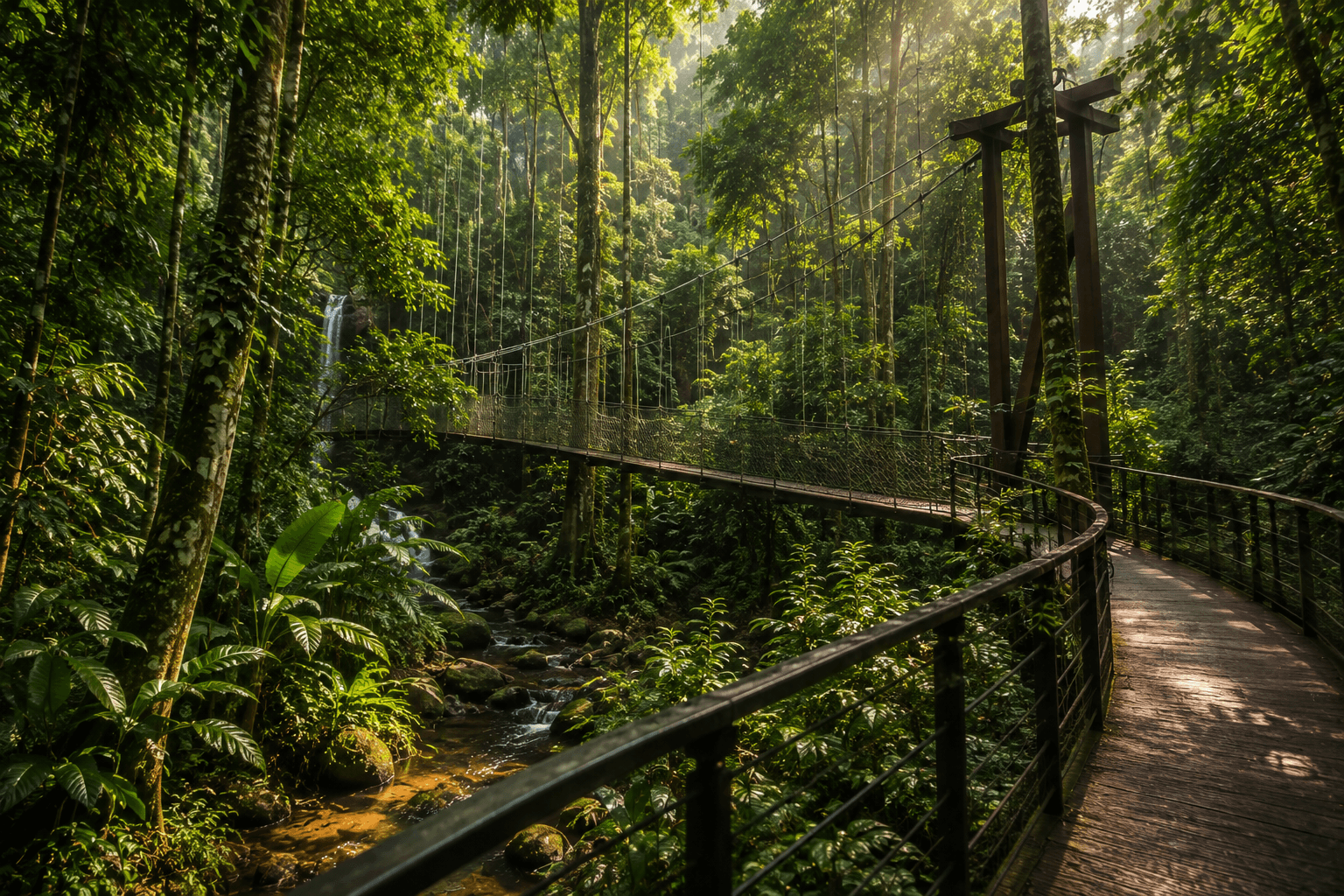
A rainforest in central Kuala Lumpur
The city quickly fades into the background as you step into the forest. Mature tropical trees shade the paths, and the buildings that surround Bukit Nanas appear through the vegetation as you walk.
| What you’ll find | Why it matters |
|---|---|
| Forest trails | Short walks through the wooded slopes of Bukit Nanas |
| Canopy walkway | An elevated route through the trees |
| City views | Glimpses of KL Tower and Kuala Lumpur's skyline |
| Wildlife | Opportunities to spot birds, insects and monkeys |
The KL Forest Park's location makes it a practical choice for travelers on a tight schedule. You can enjoy the forest without spending a large part of your day traveling outside the city.
The history of Bukit Nanas Forest Reserve
The story of this forest goes back more than a century. Bukit Nanas Forest Reserve was gazetted as a permanent forest reserve in 1906, long before Kuala Lumpur developed the dense skyline you see today.
That history is easy to overlook when you're standing beneath the trees with KL Tower nearby. Yet the forest has remained part of the city's landscape as roads, commercial areas and high-rise buildings expanded around it.
Why the forest still matters today
Bukit Nanas preserves a patch of tropical forest in one of Kuala Lumpur's most developed areas. Its vegetation provides habitat for birds, insects, monkeys, and other small wildlife, while the trees help maintain a natural space within the city.
For visitors, its value is also practical. You can pair a walk through the forest with nearby attractions instead of planning a separate trip outside Kuala Lumpur. KL Tower is right beside the park, making it easy to combine the two in the same outing.
The result is a very different kind of Kuala Lumpur experience: a forest walk, city views, and major landmarks within the same small area.
Explore the KL Forest Eco Park Canopy Walk
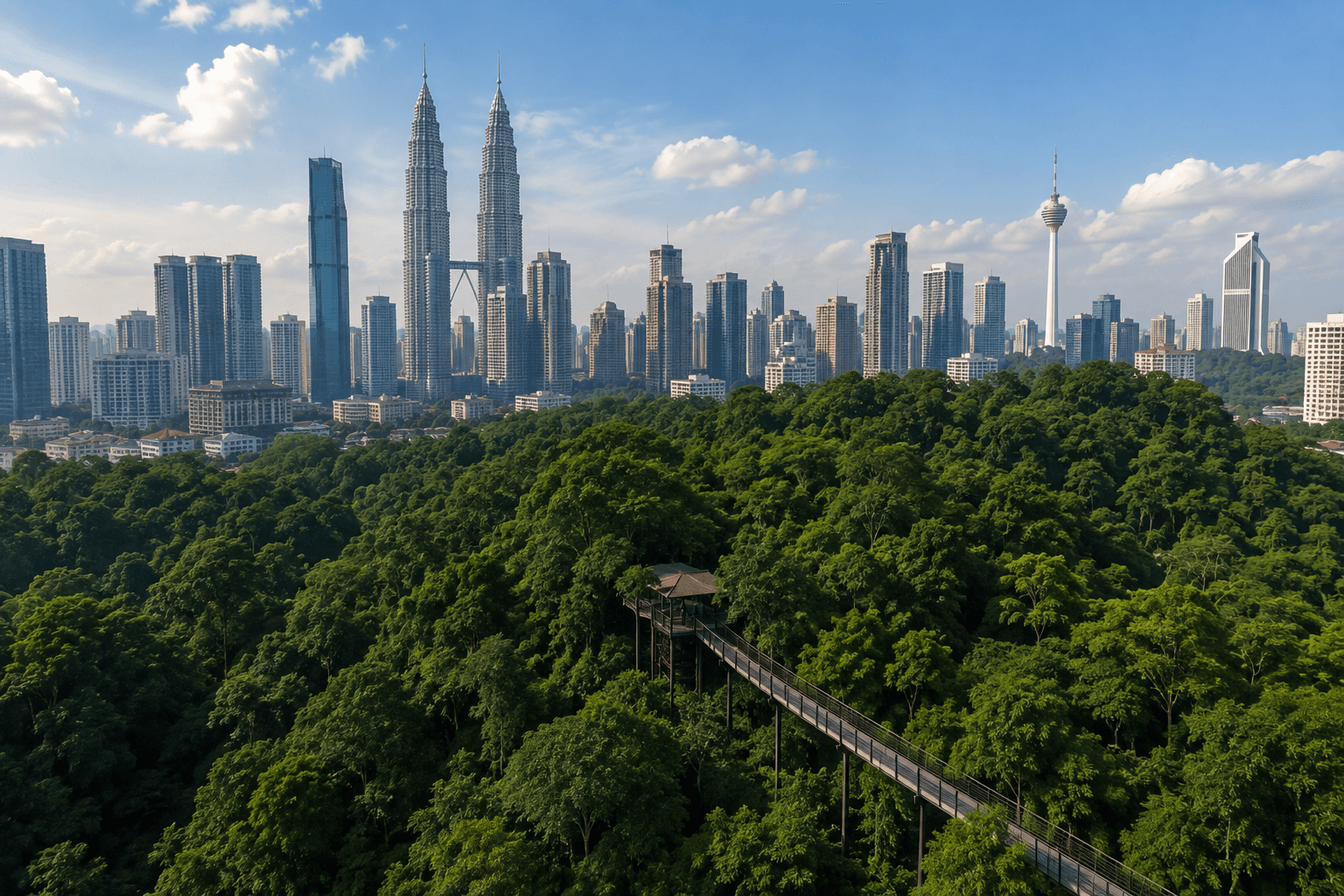
The canopy walk lets you experience the forest from above, offering a different view of KL Forest Eco Park. Instead of staying on the ground, you climb into the treetops and follow an elevated walkway with Kuala Lumpur's skyline appearing through the foliage.
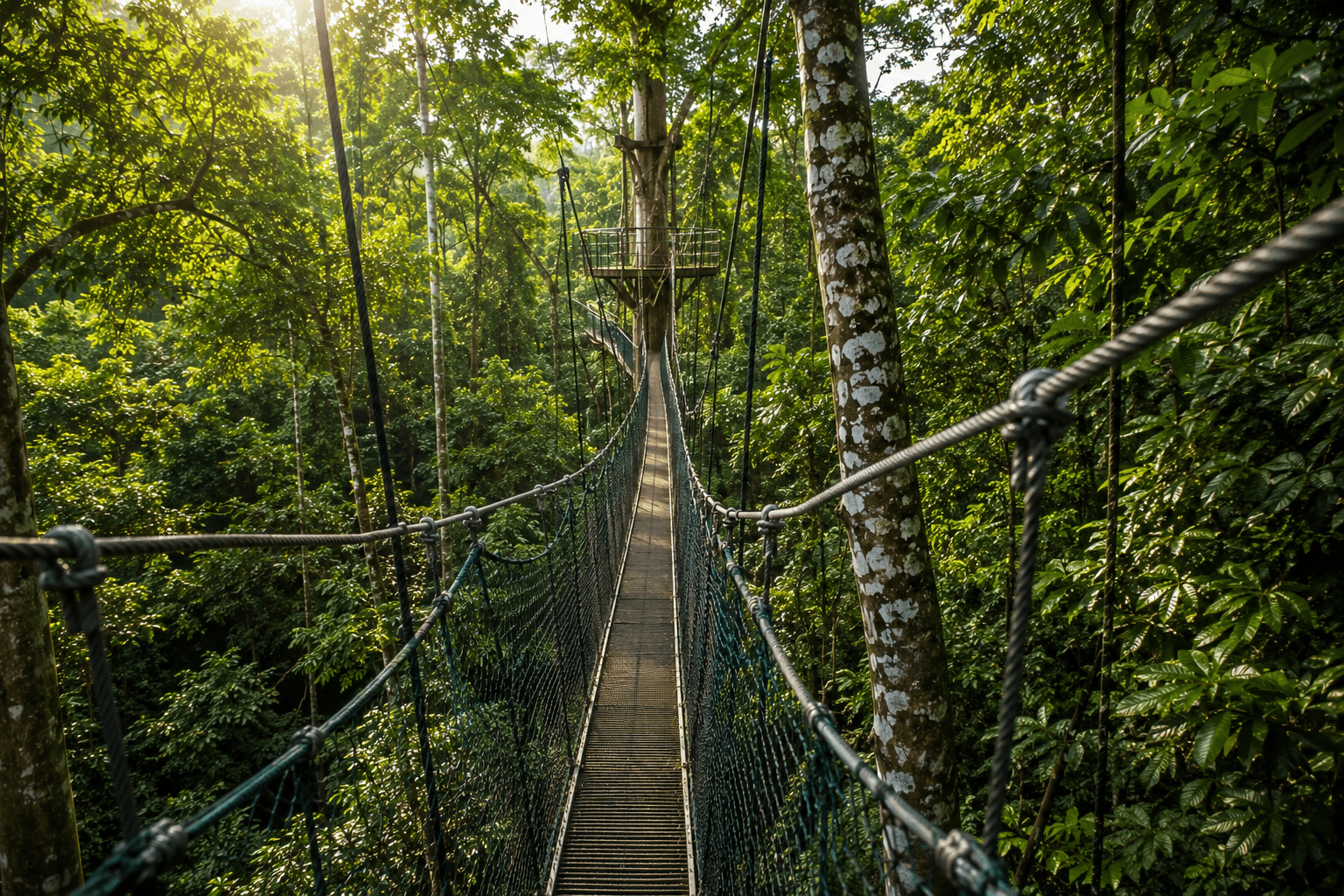
What the canopy walkway is like
The walkway stretches about 200 metres and reaches roughly 21 metres above the ground. It is built from wood and steel and runs between elevated sections and platforms among the trees.
You don't need hiking skills to use it, but you should be comfortable with stairs and some height. Take your time at the platforms rather than rushing through, especially if you want to look closely at the forest canopy.
A relaxed crossing can take around 30–45 minutes if you stop for photos and views.
What you can see from the canopy
The best part isn't simply being above the trees. Look outward, and you'll notice how quickly the forest gives way to Kuala Lumpur's built-up skyline.
From different points along the walkway, you can spot:
- KL Tower rising above the trees
- Kuala Lumpur's surrounding high-rises
- The dense canopy below the walkway
- Mature trees at a much closer level than you get from the ground
The contrast is particularly striking because you're not looking at the forest from outside it. You're moving through the upper part of the trees while the city remains visible beyond them.
Is the canopy walk currently open?
The canopy walk and some trails or facilities may close temporarily due to heavy rain, bad weather, maintenance, or safety concerns. Check the park's latest visitor information before your visit to confirm which areas are open.
If the canopy walk is the main reason you're visiting, check the latest conditions before leaving, particularly after prolonged rain. That small check can save you from making the trip only to find the attraction temporarily unavailable.
Explore the KL Forest Eco Park Trails
The trails offer a different way to experience the park from the canopy walkway. Instead of viewing the forest from above, you can walk through the trees and along the slopes of Bukit Nanas. The routes pass through hill dipterocarp forest, with shaded sections that make the uphill walk more comfortable.
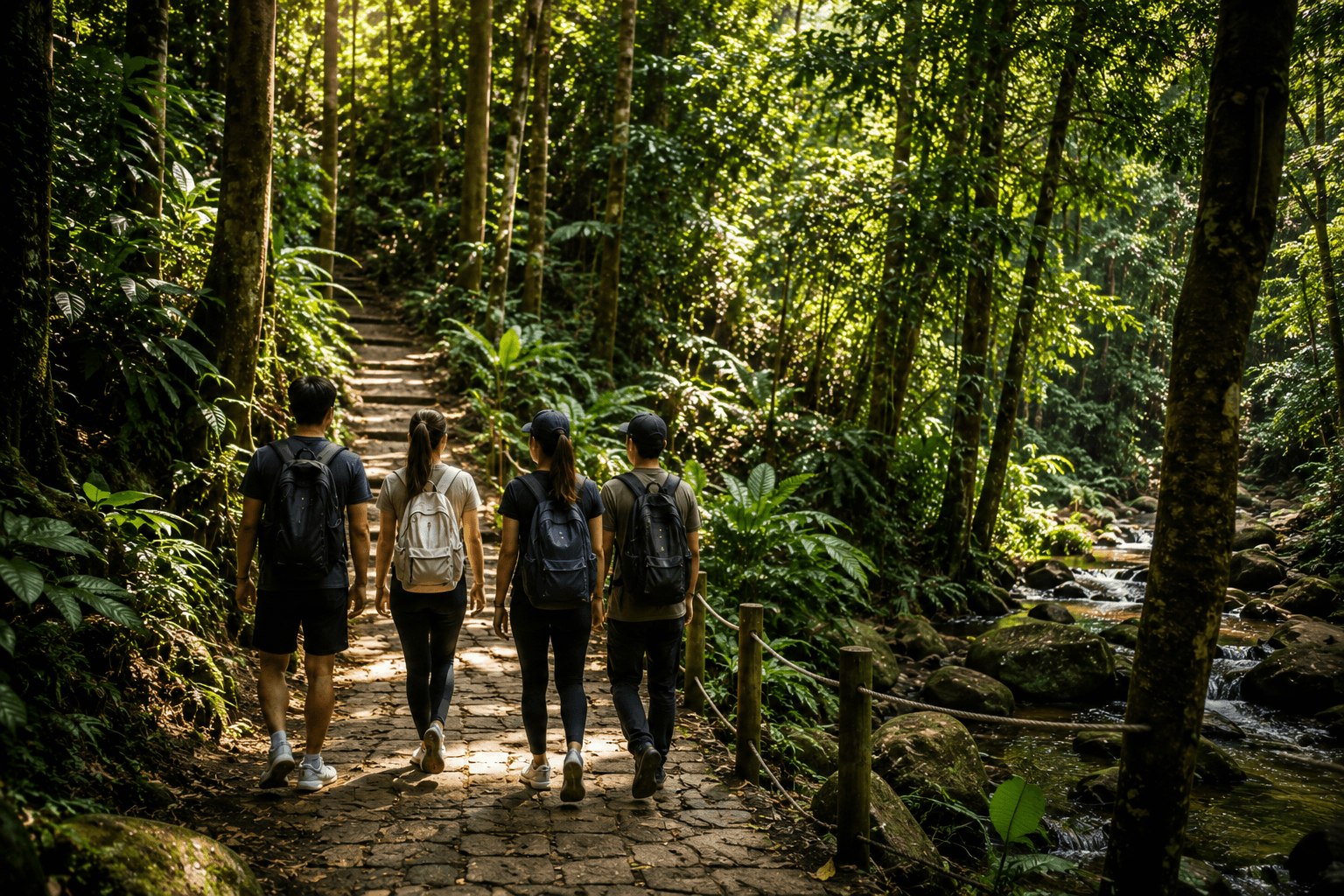
Which KL Eco Park trails can you explore?
Several named routes are associated with the forest, including Jelutong, Penarahan, Merbau and Arboretum. The exact route you can use may depend on current conditions, so follow the signs at the park rather than relying on an old trail map found online.
| Trail | What to keep in mind |
|---|---|
| Jelutong | A forest route suitable for adding more walking to your visit |
| Penarahan | Expect more uphill and downhill movement |
| Merbau | A quieter route through the forest vegetation |
| Arboretum | Useful if you want to spend more time looking at the plant life |
Don't feel that you need to complete every route. If your main plan is the canopy walk and KL Tower, a shorter trail section can easily fit into the same outing.
What are the trails like?
These are forest paths rather than perfectly level city walkways. You'll encounter slopes, steps, and uneven ground, so comfortable footwear matters more here than it would on a normal sightseeing route.
After rain, take extra care on muddy or slippery sections. Give yourself enough time to walk at a steady pace, particularly on downhill stretches.
What should you follow on the trails?
A few simple habits will make the walk safer and more enjoyable:
- Stay on marked routes and follow the park's signs.
- Don't cross barriers or enter sections marked as closed.
- Wear shoes with good grip rather than sandals or smooth-soled footwear.
- Carry water, especially if you're planning several trails.
- Keep food packed away if you encounter monkeys.
- Don't feed or approach wildlife.
- Take your rubbish with you.
- Slow down on wet steps and steep sections.
KL Forest Eco Park is well suited to trekking and nature activities, but it is still a forest reserve rather than a fully paved urban park.
How much time should you allow?
For a first visit, 1–2 hours is a practical amount of time for the main attractions plus some trail walking. If you're more interested in hiking than sightseeing, give yourself longer so you can explore at a comfortable pace.
Most importantly, don't build your itinerary around finishing a particular trail. Current access can change, so check the park's signs and latest visitor information when you arrive.
Wildlife and Plants at KL Forest Eco Park
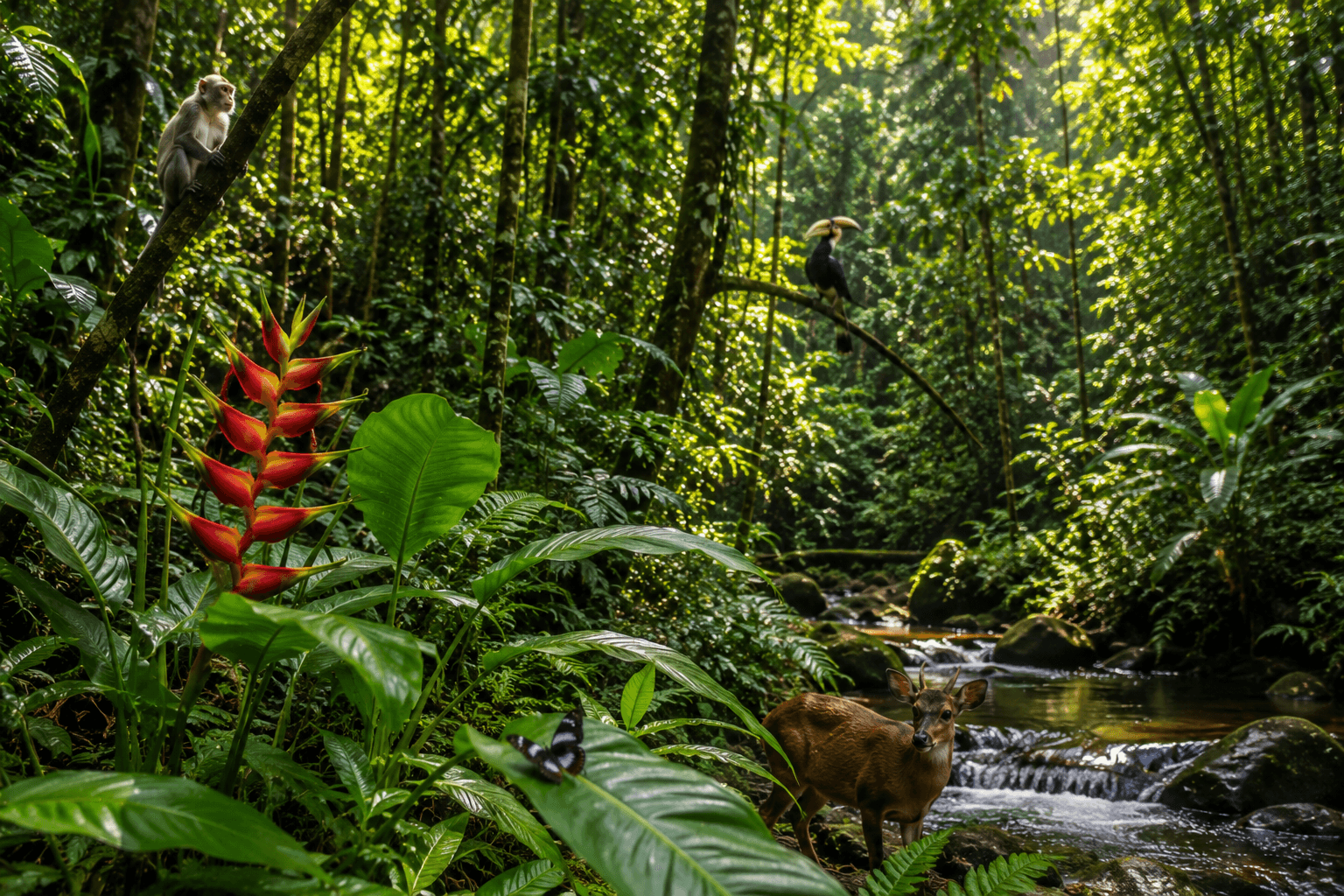
The forest is small compared with the rainforest areas outside Kuala Lumpur, but its biodiversity is surprisingly rich. A botanical survey recorded hundreds of plant species in Bukit Nanas, while a separate bird survey recorded 35 species, making the park worth exploring at a slower pace if you enjoy nature and photography.
Tropical trees and rainforest vegetation
Look beyond the walkway, and you'll notice that the forest isn't made up of just a few common city trees. Bukit Nanas retains the structure of a lowland dipterocarp forest, with tall canopy trees, smaller plants, ferns, climbers and other rainforest vegetation.
A plant survey found 425 species during a year-long study, including 16 dipterocarp species. Some trees can reach around 35 metres, so the scale of the older vegetation becomes much clearer once you're walking beneath it.
If you enjoy identifying plants, keep an eye out for:
- Large dipterocarp trees
- Ferns and other shade-loving plants
- Climbers and creepers
- Native herbs and smaller forest plants
- Mature trees rising above the lower vegetation
Birds, butterflies and insects
The forest is also a good place to slow down and listen. A 2020 bird survey recorded 35 bird species from 25 families at KL Forest Park, with many of the recorded species being resident birds.
You may notice more activity around quieter sections of the trails, particularly when you're away from busy paths. Small insects and butterflies can also appear among the vegetation, although sightings naturally vary from one visit to another.
If you're hoping to photograph birds, bring a phone or camera with some zoom and avoid rushing through the trails. Staying still for a few minutes can reveal much more than simply walking past.
Monkeys and other wildlife
Monkeys are among the more noticeable animals you may encounter. The forest is known for long-tailed macaques and silvered langurs, while other wildlife recorded in the wider Bukit Nanas area includes squirrels, monitor lizards, snakes and a range of bird species.
Don't treat a wildlife sighting as guaranteed, though. These are wild animals moving through their habitat, so you may see several during one visit and very little on another.
If you do come across monkeys:
- Keep food inside your bag.
- Don't feed or try to touch them.
- Give them plenty of space.
- Avoid making sudden movements around them.
- Let them move away rather than following them for photos.
The best approach is to enjoy the wildlife without trying to turn a chance encounter into a close-up attraction.
How KL Forest Eco Park Fits Into Kuala Lumpur's Skyline
KL Eco Park occupies a surprisingly small pocket of greenery on Bukit Nanas, right beside one of Kuala Lumpur's most recognisable towers. That means you don't have to choose between a forest walk and city sightseeing. You can experience both within the same stop.
Walking between rainforest and skyscrapers
The skyline doesn't disappear when you enter the forest. Instead, it keeps appearing in pieces between the trees. As you follow the paths, you can catch glimpses of high-rise buildings through the foliage, while the thick vegetation blocks much of the city at ground level.
The view changes as you move, so one section can look quite different from the next. The park covers around 9.3 hectares, making it large enough to feel like a real forest but compact enough to explore during a day in central Kuala Lumpur.
Connecting KL Forest Eco Park with KL Tower
KL Tower is directly beside the forest, so combining the two is one of the easiest ways to build a half-day around Bukit Nanas.
A practical order is:
| If you start with... | Then consider... |
|---|---|
| KL Eco Park | Head to KL Tower afterwards for panoramic city views |
| KL Tower | Walk down to the forest for a ground-level nature experience |
| Both attractions | Allow extra time for walking, queues and your chosen tower experience |
The contrast between the two stops is worth noticing. Inside the forest, KL Tower appears above the trees. From the tower, you get the opposite perspective and can see the forest sitting within the much larger urban landscape.
Why this spot works well for photography
You don't need a dedicated photography session to get interesting shots here. The forest naturally gives you different layers to work with: leaves and tree trunks in the foreground, the canopy around you, and Kuala Lumpur's buildings beyond it.
Try looking for:
- KL Tower partly hidden behind the trees
- The canopy walkway surrounded by greenery
- High-rises appearing between branches
- Low-angle shots of the taller trees with the skyline above them
For a more natural-looking photo, wait for a gap between visitors rather than photographing a crowded section of the walkway. Morning light can also work well for shots where sunlight filters through the canopy.
Nearby Attractions to Combine With Your Visit
You can easily turn a KL Forest Park visit into a half-day plan because two major Kuala Lumpur sights are close enough to fit around it. Start with the forest, continue to KL Tower, and finish around Merdeka Square.

A practical half-day plan
| Approx. time | Stop | Plan |
|---|---|---|
| 9:00 AM | KL Forest Eco Park | Canopy walk, selected forest trails, and photos |
| 11:00 AM | KL Tower | Observation experience and city views |
| 1:00 PM | Lunch | Take a break before continuing |
| 2:00 PM | Merdeka Square | Explore the square, historic buildings, and nearby sights |
You can adjust the timing around your KL Tower entry time. If you prefer a slower day, visit just the forest and KL Tower, then leave Merdeka Square for another outing.
Start at KL Eco Park
Arrive in the morning and give yourself around 1–2 hours for the forest. Use this time for the canopy walkway, a few accessible trails, and photos rather than trying to cover every route.
Starting here also means you can tackle the steeper trail sections before the hotter part of the day.
Continue to KL Tower
Once you're finished at the forest, head towards KL Tower. Its location beside Bukit Nanas means you don't need to arrange another cross-city journey. The experience also gives you a completely different perspective.
From the forest, you see KL Tower rising above the trees. At the tower, you can look back over the forest and across Kuala Lumpur from above.
End at Merdeka Square
After KL Tower, continue towards Merdeka Square for the final part of the route. Spend some time around the square and its surrounding historic buildings before stopping for a meal or heading back to your hotel.
This route works particularly well if you want to cover nature, Kuala Lumpur's skyline, and its historic centre without spending most of the day travelling between attractions.
Best Time to Visit KL Forest Eco Park
Your timing can make a noticeable difference here because you’ll be walking outdoors and using forest trails. Heat, rainfall and visitor numbers can all affect how comfortable the visit feels, so a quick look at the trade-offs is useful before you set out.
Morning vs afternoon
| <br> | Morning | Afternoon |
|---|---|---|
| Walking comfort | Usually more comfortable for trails and the canopy walk | Can feel hotter, especially on exposed sections |
| Visitor levels | Often quieter earlier in the day | More visitors may arrive later |
| Photography | Softer light can work well through the trees | Brighter light can create stronger contrasts |
| Best for | Trail walking and a relaxed start | Combining the park with later city sightseeing |
For most visitors, morning is the more practical choice, particularly if the forest is one of the main reasons for your visit. You can explore the trails before the day gets hotter and then continue to KL Tower or other central attractions.
Rain and trail conditions
Rain matters more here than simply deciding between a sunny and cloudy day. Wet weather can make forest paths, steps and slopes slippery, and heavy rain can also affect access to outdoor areas.
| Weather condition | What it means for your visit |
|---|---|
| Dry morning | Good conditions for trails and the canopy walkway |
| Light rain | You may need to slow down and take extra care on wet surfaces |
| Heavy rain | Consider postponing trail activities until conditions improve |
| Rain after a dry spell | Paths may become muddy or slippery even after the rain stops |
If rain starts during your visit, don't rush through slippery sections just to stay on schedule. It's better to pause and check conditions before continuing.
Weekdays vs weekends
| <br> | Weekdays | Weekends |
|---|---|---|
| Crowds | Generally easier to find quieter stretches | More visitors, especially around popular areas |
| Trails | Better if you want a calmer walk | Can feel busier at popular access points |
| Photography | Easier to wait for clear shots | You may need more patience around busy sections |
| Best for | Visitors who prefer a quieter experience | Travelers fitting the KL Eco Park into a weekend itinerary |
If you have flexibility, a weekday morning gives you the best combination of cooler conditions and fewer people. If you're visiting on a weekend, arriving earlier can help you enjoy the main areas before they become busier. One thing to check before leaving: trail and canopy access can change because of weather, maintenance, or temporary closures. Always follow the latest signs and visitor information at the park rather than assuming every area will be accessible.
Final Thoughts
KL Forest Eco Park is one of those Kuala Lumpur stops that works because of its location. You can walk beneath mature rainforest trees, cross the canopy walkway, and see KL Tower rising above the forest, all without leaving the city centre.
You don't need a full day here. Around 1–2 hours is enough for the main experience, while adding KL Tower and Merdeka Square can turn it into a useful half-day itinerary.
Before you go, check the latest access conditions, especially if rain is expected. Wear shoes with good grip, carry water, and give yourself enough time to enjoy the trails instead of rushing through them.
If you want a short break from Kuala Lumpur's buildings and traffic without travelling far from the city, KL Eco Park is well worth adding to your itinerary.